

Disease · fungal · affects American cranberry, Citrus, Elm
Especially harmful
Citrus Black Spot
Phyllosticta citricarpa
Description
Symptoms
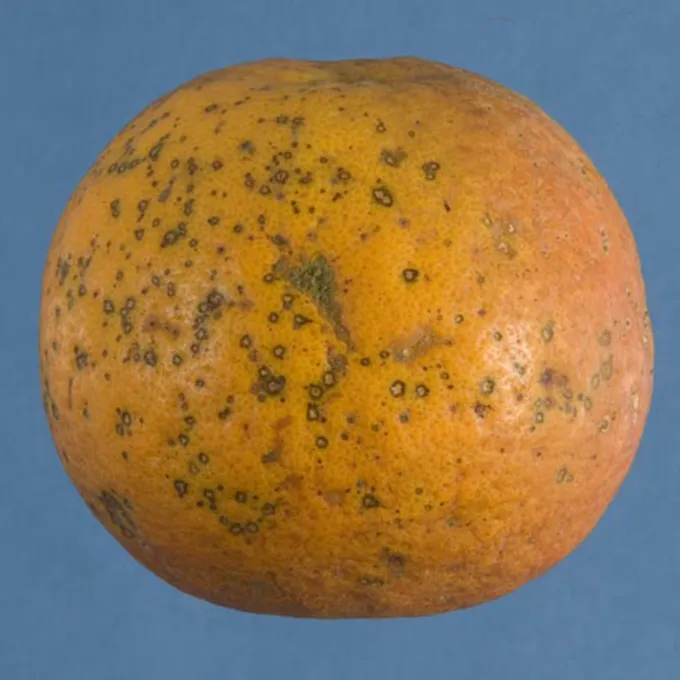
Symptoms on fruit often appear as small, dark, circular spots (often called "freckle spot") that may progress into larger, necrotic lesions with a dark or black margin, sometimes slightly sunken.
Leaf symptoms typically manifest as small, dark brown or greyish spots with a yellow halo. Over time, these spots can enlarge and coalesce, eventually leading to chlorosis and premature leaf drop.
On twigs and stems, the fungus can cause dieback and small necrotic lesions, which significantly weaken the tree and reduce its overall vigor and ability to produce high-quality fruit.
A major challenge for producers is that symptoms may remain latent on fruit during growth, only appearing after harvest when the fruit is stored under warmer, humid conditions during transit.
Microscopic examination of the lesions reveals the presence of pycnidia, small black fruiting structures, which produce masses of spores that facilitate the secondary spread of the disease within the tree canopy.
Pathogen
Citrus Black Spot is caused by the fungus Phyllosticta citricarpa (teleomorph Guignardia citricarpa). It is a significant fungal pathogen that affects various citrus species, posing a major threat to commercial citrus orchards globally.
The fungus survives on fallen leaves, where it develops sexual fruiting bodies (pseudothecia). During periods of rainfall, these structures release ascospores, which are then dispersed by wind and rain splashes to infect healthy plant tissues.
Due to its potential to cause severe economic damage and its ability to remain latent in fruit and plant material, it is classified as a quarantine organism in many countries, necessitating strict biosecurity measures.
The pathogen is highly adaptable and can affect other hosts besides citrus, including species like papaya, pear, rose, elm, and cranberry, although the disease profile varies significantly among these different plant types.
The life cycle of P. citricarpa is complex, involving both an asexual phase (producing conidia) and a sexual phase, allowing the fungus to persist in various environmental conditions and spread efficiently across orchards.
Conditions for development
The development of Citrus Black Spot is heavily dependent on specific climatic conditions, primarily high humidity and temperatures between +20°C and +30°C, which are optimal for fungal spore germination.
Rainfall is the most critical environmental factor; rain splash is necessary to liberate ascospores from infected leaf litter and spread them to healthy leaves, fruit, and twigs.
Orchards with high tree density and poor pruning practices often suffer more severe infections because the lack of airflow maintains high humidity within the canopy for longer periods.
Tree age and health play a role; younger trees or those stressed by nutrient deficiencies, pest pressure, or unfavorable soil conditions are often more susceptible to rapid infection by P. citricarpa.
The duration of leaf wetness is a key parameter; if foliage stays wet for several consecutive hours during the growing season, the risk of successful fungal infection increases dramatically.
Why it matters
The primary economic harm is the rejection of fruit from international export markets, as Citrus Black Spot is a strictly regulated quarantine disease that renders fruit aesthetically unmarketable.
Severe infections can cause significant yield losses due to premature fruit drop, where affected fruits abscise from the tree long before they reach maturity, resulting in massive production gaps.
Long-term infestation weakens the trees, leading to chronic dieback and reduced canopy density, which limits the tree's photosynthetic capacity and significantly shortens the lifespan of the orchard.
Fruit that appears healthy at the time of picking can develop severe spotting during storage, leading to complete rejection of shipments upon arrival at the destination, which causes massive financial losses.
Control programs impose heavy financial burdens on growers, including the cost of frequent fungicide applications, labor-intensive sanitation, and the administrative costs of strict phytosanitary compliance.
Protection
The foundation of effective management is the exclusive use of disease-free, certified nursery stock to prevent the introduction of the pathogen into new or clean growing areas.
Sanitation practices are vital: growers must regularly remove and destroy infected plant debris, especially fallen leaves, which act as the primary inoculum reservoir for the fungus.
A scheduled fungicide program, focusing on copper-based products, is typically implemented during critical growth stages, such as flowering and fruit development, to protect susceptible tissues from infection.
Integrated Pest Management (IPM) strategies, including canopy management and proper pruning, help improve airflow, reduce moisture accumulation, and minimize the duration of leaf wetness.
Monitoring systems that correlate local weather data with known infection models allow growers to time their protective treatments precisely, maximizing efficacy while reducing overall chemical use.
In brief
6
Affects crops
Biology
Pathogens and affected parts
Pathogens
Phyllosticta citricarpa· fungus
Ramularia nigromaculans· fungus
Mycosphaerella nigromaculans· fungus
Asteroma ulmeum· fungus
Gloeosporium ulmeum· fungus
Stegophora ulmea· fungus
Asperisporium caricae· fungus
Cercospora papayae· fungus
Phomopsis caricae-papayae· fungus
Alternaria alternata· fungus
Diplocarpon rosae· fungus
Marssonina rosae· fungus
Affected plant parts
whole plant
Content graph
Affects crops · 6
Content graph
Connections · Citrus Black Spot
Most often together:
Marketplace
Products · 17
Community
Discussion
No discussions yet — be the first.