
Description
Symptoms
The primary symptom is the rapid wilting of leaves on individual branches, which often leads to the death of the entire canopy.
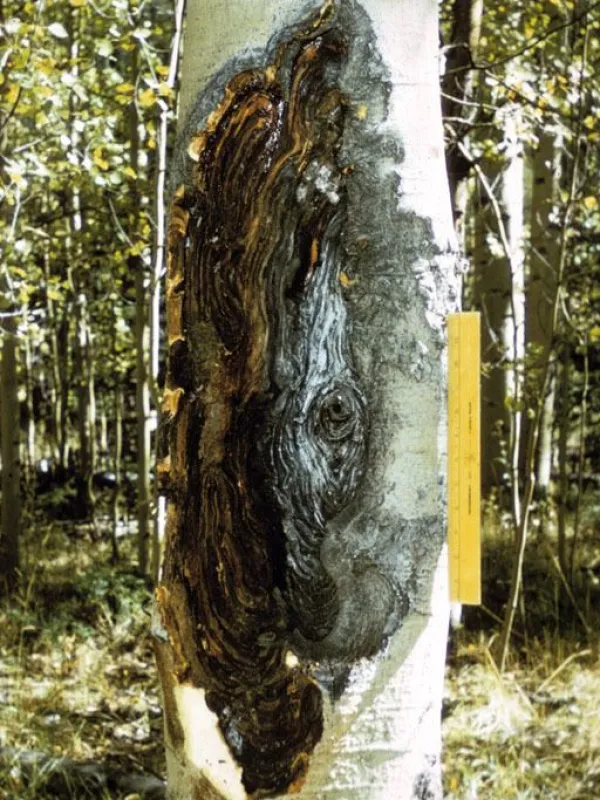
Cankers and longitudinal cracks appear on the trunk and limbs, revealing dark, necrotic tissue underneath the bark layer.
Stone fruits frequently exhibit excessive gummosis, where sap exudes from infected areas as a defense mechanism against the invasion.
Cross-sections of affected branches show distinct dark, reddish-brown, or black staining, indicating where the fungus has colonized the wood.
As the infection progresses, the bark may peel away from the wood, and the tree may become brittle and prone to breakage.
Pathogen
The disease is caused by the pathogenic fungus Ceratocystis fimbriata, which is an ascomycete fungus that infects the vascular system of woody plants.
This pathogen persists in the soil and contaminated debris, maintaining its viability for long periods before finding a susceptible host.
The fungus produces spores that can move through the xylem, causing systemic infection that disrupts the flow of water and nutrients throughout the tree.
Different host-specific strains of this pathogen exist, targeting diverse species such as plane trees, apricots, almonds, and peaches.
In laboratory settings, the fungus is characterized by its growth on specific media, where it produces distinct reproductive structures.
Conditions for development
High humidity and mild to warm temperatures are critical environmental factors that promote the germination and spread of fungal spores.
Mechanical injuries caused by pruning tools, storm damage, or equipment are the main entry points for the pathogen into the tree.
The pathogen is easily transmitted via infected equipment that has not been properly sterilized between trees, spreading the disease rapidly in orchards.
Insects that feed on wood or bark can act as vectors, carrying spores from diseased trees to healthy ones during the growing season.
Poor site management, including soil compaction or excess water, can weaken tree resistance and make them more susceptible to colonization.
Why it matters
Ceratocystis canker is a highly destructive disease capable of killing mature trees within a single growing season under optimal conditions.
The economic impact on stone fruit production is significant due to the loss of both fruit yield and the tree itself.
In urban landscapes, this pathogen poses a safety risk, as infected branches become unstable and may fall, potentially causing damage or injury.
The disease forces the removal of established trees, leading to long-term landscape loss and substantial costs for disposal and replacement.
The persistent nature of the fungus in the soil prevents the immediate replanting of susceptible species in the same location without prior treatment.
Protection
Strict sanitation protocols are the most effective management tool, including the sterilization of all pruning equipment with a bleach solution.
Infected trees should be immediately removed, including the stump, and destroyed by burning to eliminate the source of inoculum.
Minimize physical wounds on trees by careful maintenance and avoiding unnecessary cuts or damage to the bark and roots.
Regular inspection and early detection are crucial to isolating affected areas and preventing the spread of the fungus to healthy neighbors.
- Sterilize all cutting tools.
- Remove and burn infected trees.
- Avoid pruning during wet weather.
- Monitor for vector insects.
Pathogens and affected parts
Affects crops · 4
Discussion
No discussions yet — be the first.