
Description
Symptoms
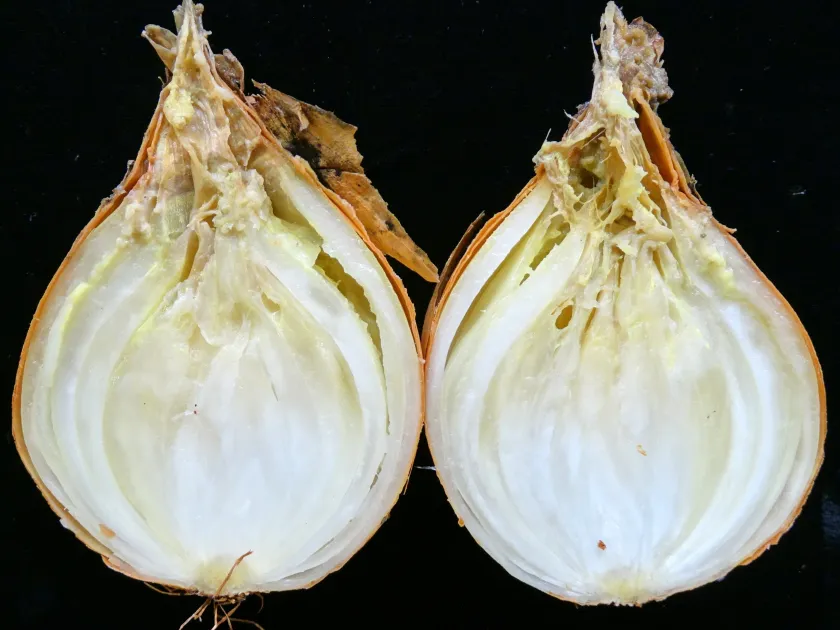
Symptoms often emerge late in the season or after harvest, typically manifesting as decay inside the center of the bulb.
External appearance of the bulb might seem healthy, while the internal fleshy scales are already turning soft and watery.
As the disease progresses, the affected internal layers turn brown, yellow, or even black, developing a distinctive foul odor.
In advanced stages, the entire center of the onion or garlic bulb degrades into a slimy, disorganized mass of tissue.
- water-soaked internal scales;
- distinctive putrid smell;
- yellowing or collapse of leaves;
- brown discoloration of the bulb core;
- premature decay in storage.
Pathogen
The causative agent of center rot is a complex of bacteria from the genus Pantoea, most notably Pantoea ananatis.
These bacteria are gram-negative, rod-shaped pathogens that thrive in a wide range of environmental conditions and climates.
They are capable of living as epiphytes on the surface of plant tissues without causing immediate visible damage to the host.
Survival occurs through plant debris, contaminated soil, and infected seeds, allowing the pathogen to persist across growing seasons.
The infection process involves the secretion of cell-wall-degrading enzymes that break down vegetable tissue, leading to rapid decay.
Conditions for development
High temperatures combined with excessive humidity are the primary triggers for rapid disease development in the field.
Mechanical damage caused by harvest equipment or insect feeding provides entry points for the bacteria to colonize the bulb.
Poor drying conditions after harvest leave the neck of the onion open and succulent, facilitating bacterial entry into the bulb.
Thrips and other insect pests play a major role as vectors, transferring the pathogen from infested plants to healthy ones.
Over-irrigation, especially during the maturation phase, increases the susceptibility of the crop to bacterial invasion.
Why it matters
Center rot poses a significant risk to post-harvest quality, often leading to total loss of marketability for infected bulb batches.
The disease causes substantial financial losses for growers due to the hidden nature of the infection that spreads during storage.
The presence of diseased bulbs in storage containers can lead to secondary infections, ruining large volumes of otherwise healthy produce.
It reduces the shelf life of onions and garlic, making long-term supply chain management impossible for affected produce.
On a field level, the disease can cause significant stand reduction and decrease the total harvest yield per hectare.
Protection
Prevention starts with selecting certified, pathogen-free seeds and sets to avoid introducing the bacteria into the field.
Implementing effective pest management, especially for thrips, is crucial to minimize the spread of the bacteria via insect vectors.
Rapid and thorough drying of bulbs after harvest is essential to ensure the neck tissues close tightly and remain dry.
Crop rotation practices should be followed to reduce the accumulation of the pathogen in the soil over several growing cycles.
Copper-based bactericides may be applied during the growing season to suppress the bacterial population, though they are only moderately effective.
Pathogens and affected parts
Affects crops · 2
Discussion
No discussions yet — be the first.