
Description
Symptoms
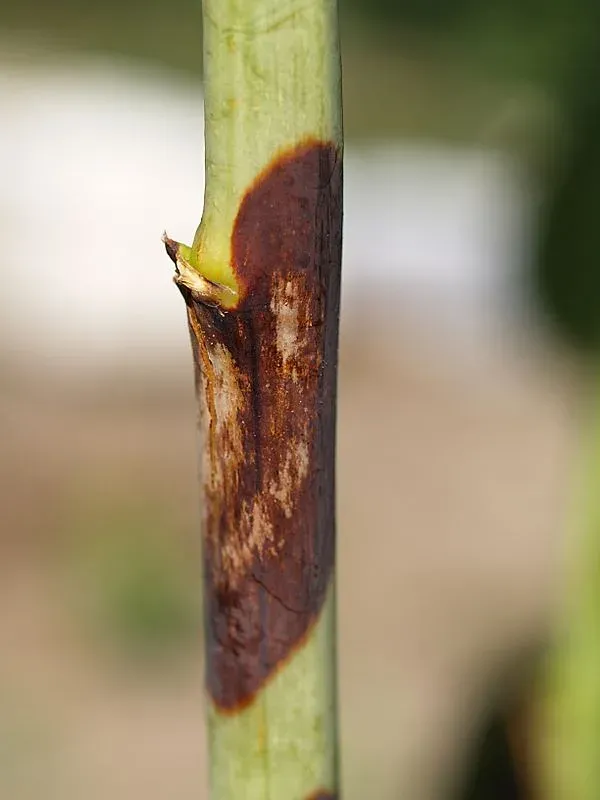
The disease typically manifests as dark purple or brown lesions appearing at the nodes where leaf petioles attach to the stem.
As the infection progresses, these spots expand, often merging to create large, irregular necrotic areas on the stem surface.
Small, dark, pinpoint-like structures, which are the fungal pycnidia, become visible within the dead or dying plant tissue.
When it affects industrial hemp, Didymella can cause stem necrosis that significantly weakens the fiber quality and reduces crop vigor.
Leaves on infected sections often turn yellow and fall prematurely, causing the plant to lose its photosynthetic capability.
Pathogen
The causative agent of Didymella blight is the ascomycete fungus Didymella applanata, which primarily targets plant stems.
This pathogen acts as a parasite that exploits the plant's vascular and epidermal tissues, leading to severe structural damage.
The life cycle involves both sexual and asexual stages, enabling the fungus to adapt and spread effectively across various host species.
The pathogen overwinters as mycelium and fruiting bodies (pycnidia) within crop residues, soil, and affected plant parts.
Environmental conditions trigger the release of spores, which are disseminated by wind and splashing rain to infect healthy tissue during the growing season.
Conditions for development
High humidity and consistent rainfall are the primary factors that facilitate the germination and spread of Didymella spores.
Moderate temperatures ranging from 15 to 22 degrees Celsius create an optimal climate for the rapid proliferation of the fungal colony.
Dense planting schemes that prevent airflow and trap moisture around the base of the plant are highly conducive to the development of the blight.
Insects that bore into or bite the stems create wounds that serve as ideal entry points for the fungal mycelium.
Imbalanced soil nutrition, specifically excessive nitrogen, results in overly succulent tissue that is more vulnerable to pathogen invasion.
Why it matters
Didymella blight causes a substantial reduction in yield due to the inhibition of nutrient transport along the stems.
The structural integrity of the plant is compromised, often leading to lodging, stem breakage, and total loss in severe infestation scenarios.
Quality parameters for fiber-producing plants like hemp are drastically lowered, making the harvest unsuitable for industrial processing.
Chronic infections weaken perennials, causing them to fail during winter dormancy or become susceptible to other opportunistic pathogens.
The economic impact is compounded by the cost of intensive fungicide applications and the loss of viable planting material.
Protection
Sanitation practices, including the removal and burning of infected plant debris, are essential to break the infection cycle.
Improving canopy ventilation through proper spacing and pruning reduces moisture retention and inhibits fungal growth.
Applying protective and systemic fungicides during the early spring and rainy periods is a standard management strategy.
Selecting resistant cultivars and maintaining soil fertility with balanced nutrients helps plants develop stronger physical barriers.
Integrated pest management (IPM) to control stem-boring insects is crucial, as it limits the physical trauma necessary for fungal infection.
Pathogens and affected parts
Affects crops · 1
Discussion
No discussions yet — be the first.