
Gray mold
Botryotinia fuckeliana
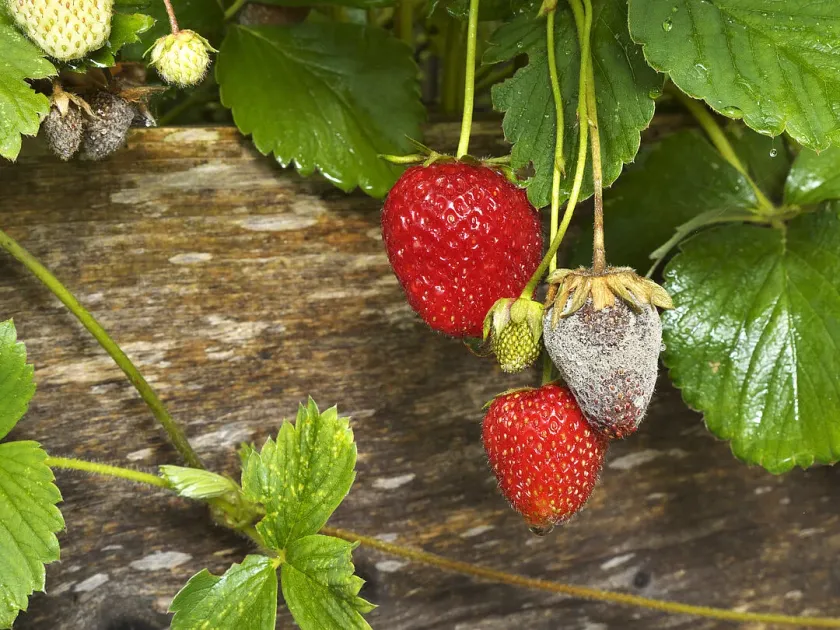
Description
Symptoms
The most diagnostic sign is the appearance of a fuzzy, gray, dusty mass of spores (conidia) on infected leaves, stems, flowers, or fruit.
Initially, water-soaked spots appear on the plant tissue, which soon turn brown and expand rapidly under humid conditions.
Stems affected by gray mold often exhibit girdling lesions that cause the distal portions of the plant to wilt and collapse.
Flowers and flower buds are particularly sensitive, often showing petal blighting and rapid decay, which prevents normal blooming.
On fruits and storage organs, the fungus causes soft rot, often covered with a thick gray mycelial mat, which can quickly spread through containers of harvested produce.
Pathogen
The causal agent of gray mold is the necrotrophic fungus Botryotinia fuckeliana (anamorph Botrytis cinerea). It is a highly destructive pathogen with a broad host range.
The fungus produces large amounts of conidia, which are easily wind-dispersed, and survival structures called sclerotia that persist in the soil and debris for years.
This pathogen infects a diverse group of plants, including peanut, Browallia speciosa, Calceolaria, Campanula carpatica, Clerodendrum thomsoniae, Cyclamen persicum, Exacum affine, and Fuchsia.
It secretes a variety of enzymes and toxic metabolites that break down host plant tissues, allowing the fungus to colonize and kill plant cells rapidly.
Infections typically begin when spores land on susceptible plant surfaces, particularly those that are moist or have been damaged by other pests or environmental stress.
Conditions for development
Gray mold thrives in cool to moderate temperatures, typically ranging from 15°C to 22°C, combined with high relative humidity levels.
Prolonged leaf wetness, often caused by rainfall, heavy dew, or improper overhead irrigation, is critical for the germination of fungal spores.
Poor air circulation within dense plant canopies or greenhouse environments creates stagnant, humid pockets that favor infection.
Stressed or mechanically wounded plants are significantly more susceptible to Botryotinia fuckeliana compared to healthy, vigorous plants.
Low light levels and lack of proper hygiene, such as leaving fallen blossoms or decaying leaves on the ground, encourage the proliferation of the pathogen.
Why it matters
This disease is responsible for significant economic losses in horticulture and agriculture, affecting both pre-harvest yield and post-harvest quality.
In greenhouses and nurseries, it can cause severe stand loss in seedling trays, necessitating complete replacement of crops.
Ornamental plants infected by the fungus lose all aesthetic value, resulting in immediate market loss for producers.
The pathogen's ability to spread rapidly in storage means that even minor infections at the time of harvest can ruin entire batches of products.
Long-term impact includes the buildup of soil-borne inoculum, which makes future cropping cycles much harder to manage without intensive interventions.
Protection
Sanitation is the first line of defense: remove and destroy all infected plant materials to reduce the amount of inoculum in the environment.
Improve air circulation by pruning dense foliage and spacing plants properly to ensure that moisture does not accumulate on leaf surfaces.
Manage humidity levels in greenhouses through proper ventilation and avoid overhead irrigation to keep foliage as dry as possible.
Apply preventive or curative fungicides, ensuring proper rotation of active ingredients to prevent the development of resistant fungal populations.
Integrate biological control agents like Trichoderma harzianum or Bacillus subtilis into the management program to suppress fungal growth naturally.
Pathogens and affected parts
Affects crops · 19
Discussion
No discussions yet — be the first.