
Description
Symptoms
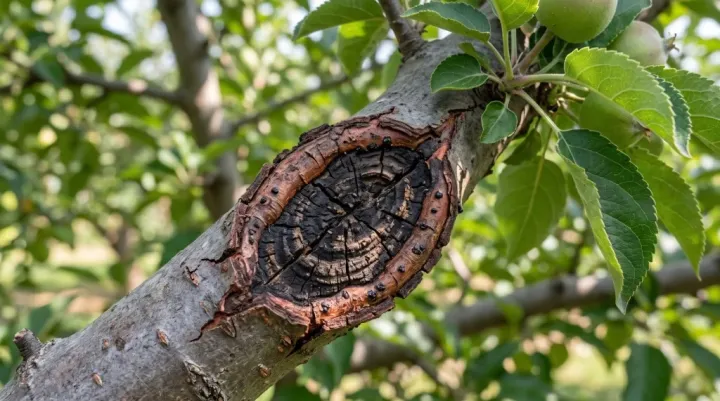
Early symptoms appear as small, reddish-brown, slightly sunken spots on the bark, which gradually expand and darken to a deep, charcoal-black color.
Affected bark may crack, become papery, or slough off entirely, revealing the darkened, necrotic wood underneath the site of the infection.
Leaf symptoms, often called "frog-eye" spots, appear as small purple-bordered lesions that eventually develop concentric rings of dead tissue.
Fruit infection starts as firm, brown, depressed spots that rapidly enlarge and turn black, often covered with tiny, dark, raised dots (pycnidia).
As the rot progresses, the entire fruit shrinks, becomes shriveled, and turns into a black mummy, often persisting on the tree through the winter.
Pathogen
The disease is caused by the ascomycete fungus Botryosphaeria obtusa (anamorph: Sphaeropsis malorum), a common and destructive pathogen of apple trees.
The fungus overwinters primarily as mycelium in cankers on the bark, on dead twigs, and within mummified fruits left hanging on the tree.
During the growing season, pycnidia produce conidia (spores) that are dispersed primarily by rain splashes, wind currents, and human activity during pruning.
Infection usually begins through wounds, such as those caused by pruning, winter freezing, sunscald, or insect feeding, which serve as entry points.
Once inside, the fungus spreads through the bark and sapwood, interfering with the vascular system and potentially killing the affected branches.
Conditions for development
The development of black rot is favored by warm, humid conditions, particularly when frequent rain occurs during the spring and summer months.
Stress factors, including poor soil nutrition, drought, or extreme cold in winter, make trees significantly more susceptible to the fungal invasion.
Trees that have sustained structural damage, such as frost cracks or sunscald, provide a perfect environment for the fungus to establish its colonies.
Poor orchard sanitation and overcrowding contribute to higher inoculum pressure, allowing spores to spread easily between adjacent trees.
Extended periods of high moisture facilitate the germination of conidia, leading to rapid infection of young succulent tissues and wounded bark.
Why it matters
Black rot is a serious disease that can lead to significant yield loss, reduced fruit quality, and, in severe cases, the death of the entire tree.
Cankers that girdle the trunk or major limbs cut off the flow of nutrients and water, causing death of the distal parts of the branch.
Severe defoliation resulting from leaf spot infections reduces the tree's vigor and its ability to store carbohydrates for the following growing season.
Fruit rot renders the crop unmarketable, causing substantial economic losses for commercial orchardists and home growers alike.
The persistence of the fungus in mummified fruits and wood means that the disease will recur every year unless aggressive control measures are taken.
Protection
Sanitation is the most critical management tool: prune out and remove all dead, diseased, or cankered branches to reduce the amount of inoculum.
All prunings should be burned or buried immediately to prevent the fungus from producing new spores during the next growing season.
Ensure trees remain healthy by providing proper irrigation and fertilization, as vigorous trees are better at compartmentalizing and resisting infections.
Protect trees from sunscald and winter injury by painting trunks with white latex paint or using protective wraps during the dormant season.
- Use copper-based fungicides as a preventative measure during dormant stages.
- Disinfect pruning tools with a 10% bleach solution between cuts.
- Remove and destroy all fruit mummies from the tree and orchard floor.
Pathogens and affected parts
Affects crops · 1
Discussion
No discussions yet — be the first.