
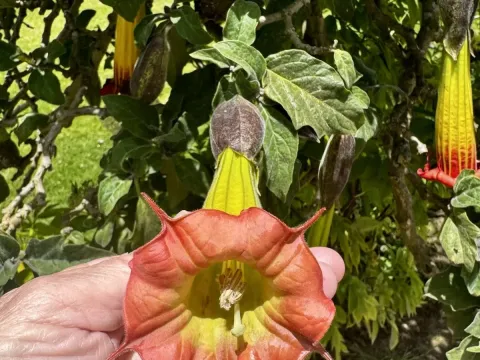
Brugmansia
Brugmansia
Brugmansia is a genus of flowering plants in the family Solanaceae, widely known for their large, fragrant, trumpet-shaped flowers. They are native to tropical regions of South America.
What the section contains


Brugmansia
Seeds should be sown in late winter or early spring to ensure a long growing season. Soaking the seeds for 24 hours prior to sowing can significantly improve germination rates.
Propagation through semi-hardwood cuttings is the preferred professional method. Cuttings of 15–20 cm are placed in a well-draining rooting medium and kept in a warm environment until roots form.
Once established, plants are moved into larger pots or outdoor beds. Brugmansia is a heavy feeder, necessitating a nutrient-rich substrate to support its rapid growth habit.
Repotting should be performed annually or as needed to prevent the plant from becoming root-bound, which stunts development and reduces the number of blossoms.
Brugmansia thrives in full sun but requires protection from extreme midday heat in very hot climates. Bright, indirect light is also sufficient in indoor settings, though bloom intensity will vary.
The soil must be highly fertile and porous. A mix rich in organic compost with excellent drainage is ideal, as the roots are sensitive to waterlogging and subsequent anaerobic conditions.
Moisture management is critical; during the active growth phase, the plant requires consistent watering. The substrate should be kept moist but never waterlogged to avoid root rot.
Regular fertilization is vital for this high-yield ornamental. A balanced NPK fertilizer with added trace elements should be applied frequently to support heavy flowering.
Temperature control is essential as the plant is not frost-tolerant. It should be kept in a frost-free environment during winter months, maintaining temperatures above 5 degrees Celsius.
Spider mites are the most common pests found on Brugmansia, especially in dry, indoor conditions. Regular misting and proper humidity levels help discourage infestations.
Whiteflies and aphids are frequent invaders that target young foliage and shoots. Integrated pest management using systemic insecticides is recommended to maintain plant health.
Fungal diseases like grey mold (Botrytis) may occur if air circulation is poor or if the foliage remains wet for extended periods. Pruning for better airflow is a key preventive measure.
Root rot is primarily an agronomic management issue caused by overwatering. It manifests as wilting despite moist soil, often requiring root inspection and substrate correction.
Monitoring the plants weekly ensures that any signs of disease or pest activity are caught early, allowing for targeted treatments before the entire plant is compromised.