
Ampelodesmos mauritanicus
Ampelodesmos mauritanicus
Description
Growing requirements
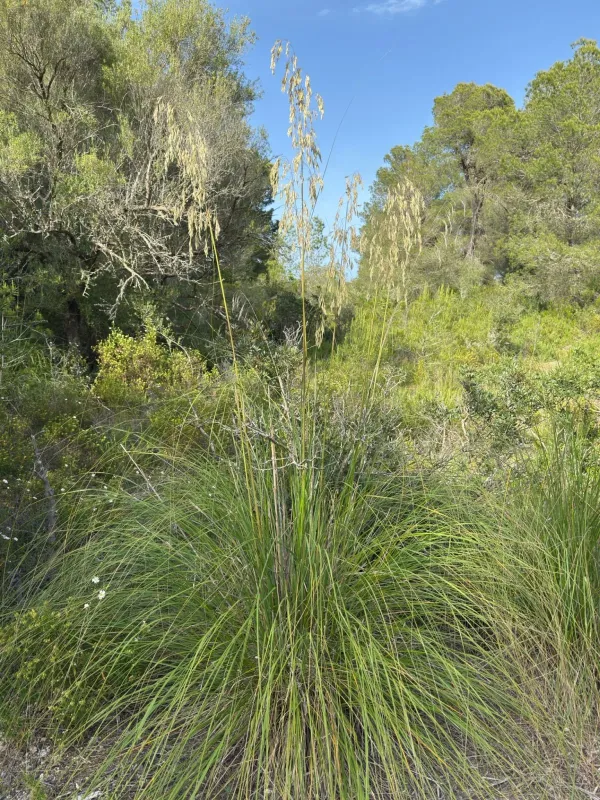
Ampelodesmos mauritanicus, commonly known as diss grass or Mauritanian grass, is a perennial robust grass belonging to the Poaceae family. It typically forms large, dense clumps reaching heights of up to two meters.
Native to the Mediterranean region, including parts of North Africa, Southern Europe, and various islands, this plant is well-adapted to Mediterranean climates. It thrives in sunny environments, often dominating rocky, nutrient-poor landscapes where other crops struggle.
The plant is highly drought-tolerant and can survive in harsh, arid conditions. Its extensive root system makes it an excellent choice for stabilizing steep slopes and preventing soil erosion in degraded areas.
Botanically, it features stiff, narrow leaves and large, feathery, spreading panicles during the flowering season. These structures are adapted to minimize water loss, allowing the plant to remain green even during prolonged dry spells.
Cultivation requires little in terms of external inputs. The species is well-suited to calcareous soils and prefers well-drained substrates. Minimal management is needed beyond periodic clearing of dead foliage to encourage new growth.
Main diseases and pests
The species possesses significant natural resistance to common cereal diseases. Its robust cell walls, fortified with phytoliths, create a physical barrier that prevents most fungal and bacterial infections from gaining a foothold.
Pest pressure on this plant is generally low. The rough texture and high silica content of the leaves make them unpalatable to most insects and herbivores, reducing the need for chemical pest control in commercial stands.
The primary threat to large populations is wildfire. During the hot, dry season, the accumulation of senescent dry leaves acts as fuel, making the grass stands highly susceptible to combustion, which can lead to significant biomass loss.
While the plant is highly competitive, human-induced environmental degradation can allow invasive weeds to colonize gaps in the stands. Maintaining proper density and periodic cleaning are essential agronomic practices to preserve stand health.
Effective stand management involves careful monitoring for excessive litter buildup. Reducing the amount of dry, dead biomass is a critical preventative measure against fire risks in Mediterranean-type ecosystems.
Harvesting
Historically, Ampelodesmos mauritanicus has been highly valued as a fiber crop. Its long, durable stems were traditionally used by Mediterranean cultures to produce strong ropes, baskets, and even fishing nets resistant to seawater decay.
In modern agricultural contexts, this species is gaining attention as a sustainable source of cellulose. The leaf mass and culms are studied for potential use in the paper industry, bio-composites, and as a feedstock for bioenergy production.
Harvesting usually occurs at the end of the summer season when the plant's metabolic activity slows down. Mechanical equipment is necessary to handle the sheer volume and toughness of the stalks, which require heavy-duty cutting gear.
Once harvested, the material undergoes drying and processing to separate the vascular fibers from the soft plant tissues. The quality and strength of the extracted fiber are highly dependent on the harvesting stage of the grass.
Beyond fiber, the dried biomass serves as a functional material for animal bedding or as an insulating layer in agricultural applications, thanks to its high durability and resistance to moisture.