
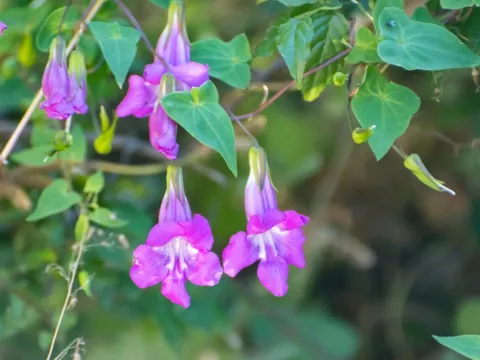
Maurandya
Maurandya
Seeds of Maurandya are sown for seedlings in late February or early March, as the culture has a rather long vegetation period before flowering begins.
What the section contains

Maurandya
For sowing, a light, fertile substrate with neutral acidity is used, which must be disinfected beforehand to prevent fungal diseases.
The seeds are spread on the surface of moist soil, just slightly covered with vermiculite or sand, as they require access to sunlight for germination.
Containers are covered with glass or film to create a greenhouse effect, maintaining a temperature in the range of 20–22 degrees Celsius.
Transplanting seedlings into individual pots is carried out in the phase of two or three true leaves, trying not to damage the fragile root system.
Maurandya is a heat-loving plant from the Plantaginaceae family, which naturally grows in the tropical and subtropical zones of Mexico and the southern United States.
The culture has high lighting requirements: for full development and abundant flowering, the plant needs direct sunlight for at least 6–8 hours a day.
Soils must be well-drained, loose, and rich in organic matter, as stagnant moisture near the roots is detrimental to this vine.
During the active growth period, Maurandya requires regular watering, however, overwatering should be avoided by allowing the top layer of soil to dry slightly between waterings.
The plant needs reliable support, as Maurandya stems can reach lengths of up to 3 meters, clinging to surfaces with their leaf petioles.
The main enemy of Maurandya in indoor conditions and high humidity is the spider mite, which sucks sap from the leaves, causing them to turn yellow.
In conditions of dense planting and poor ventilation, the plant can be affected by powdery mildew, which manifests as a white coating on the vegetative mass.
Aphids also pose a threat by settling on young shoots and buds, leading to the deformation of plant organs and a decrease in flowering intensity.
To combat pests, it is recommended to use systemic insecticides or acaricides, following the dosages indicated in the product instructions.
Disease prevention includes maintaining a proper watering schedule, regular greenhouse ventilation, and keeping the growing area clean.