
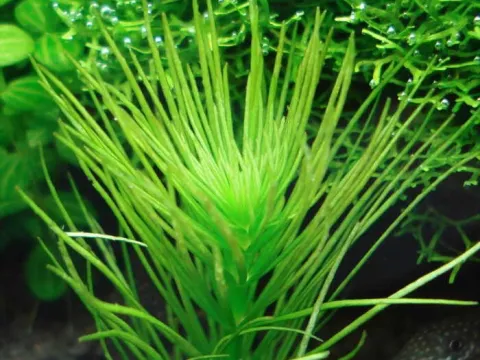
Hydrotriche
Hydrotriche
Hydrotriche is a genus of aquatic plants belonging to the Plantaginaceae family. The most widely cultivated species is Hydrotriche hottoniiflora, native to the island of Madagascar.
What the section contains

Hydrotriche
This plant thrives in tropical freshwater environments, specifically in calm, shallow waters with soft substrate and high light penetration.
Successful cultivation requires high-intensity lighting, typically ranging from 0.5 to 1.0 Watts per liter, to prevent the plant from becoming leggy and sparse.
Water parameters are critical for this species: a temperature between 22 and 28 degrees Celsius is preferred, alongside a steady supply of CO2 and regular fertilization with trace elements.
The substrate should be fine-grained and nutrient-rich, as the plant relies on a combination of root uptake and direct nutrient absorption through its needle-like leaves.
While not an agricultural crop, the productivity of Hydrotriche is measured by its propagation rate and the density of its submerged foliage.
Under optimal conditions, the plant grows rapidly, branching out frequently and forming lush green forests that provide shelter for aquatic fauna.
Propagation is most effective through stem cuttings. Sections of at least 5-10 centimeters can be replanted directly into the substrate to establish new growth.
Regular maintenance, including trimming, encourages side-shoot development, which significantly increases the overall biomass of the plant group.
Hydrotriche is highly valued in the aquascaping industry for its ability to create depth and texture within a planted tank design.
Algae infestation is the primary threat to Hydrotriche. Because the plant has fine, feathery leaves, algae can easily cover the surface, choking the plant.
Nutrient imbalances, particularly iron deficiency, lead to chlorosis, causing the tips to turn pale and become brittle or translucent.
Poor water circulation can cause organic matter to settle on the leaves, leading to tissue necrosis and decay of the lower stem segments.
Inconsistent lighting schedules often result in the shedding of leaves from the lower part of the stem, which ruins the visual appeal of the planting.
While generally robust in stable conditions, the plant is sensitive to sudden shifts in pH or hardness, which can cause physiological stress and stunted growth.