
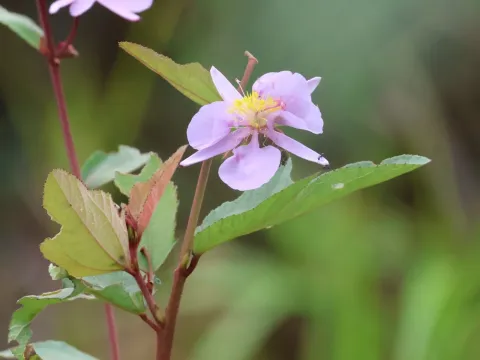
Clappertonia
Clappertonia
Clappertonia is a tropical crop, and its sowing dates are closely linked to the start of the rainy season. In equatorial climates, seeds are sown as soon as soil moisture levels become optimal for germination.
What the section contains

Clappertonia
Field preparation requires clearing the land of weeds and applying organic fertilizers to enrich the soil. Seeds should be planted at a shallow depth of 1-2 centimeters to ensure good soil-to-seed contact.
The spacing of the rows is crucial to allow the plants to develop strong, tall stems. A wide-row planting scheme is typically used to ensure adequate sunlight and nutrients for each plant.
Under optimal conditions, germination typically takes between 7 and 14 days. Protecting young sprouts from drying out during the initial weeks of growth is essential for crop success.
Agronomists suggest thinning the crop if the planting density is too high. This prevents the stems from overcrowding, which can cause them to become thin and susceptible to lodging.
Clappertonia belongs to the Malvaceae family and shares biological similarities with jute. It thrives in fertile, well-drained alluvial soils that are rich in organic matter.
Temperature is a critical factor for this crop, as it is highly sensitive to cold and cannot withstand any frost. Therefore, commercial cultivation is restricted to tropical and subtropical zones.
The plant requires intense, direct sunlight throughout the entire growing season. Shaded environments negatively impact the growth rate and the quality of the fibers produced in the stems.
Water requirements are relatively high during the active vegetative stage. While the plant has some level of drought tolerance, consistent moisture promotes the development of high-quality fiber.
Regular application of nitrogenous fertilizers is necessary to support the rapid development of the fibrous stem. Soil fertility management is the key to achieving profitable yields.
The yield of dried stems depends heavily on agronomic practices and soil quality. Clappertonia is known for its ability to produce a high volume of biomass within a relatively short period.
Under favorable tropical conditions, stems can grow as tall as 2-3 meters. This high biomass production makes it an attractive choice for fiber extraction in industrial applications.
The economic value of the crop is determined by the quality and quantity of the bast fiber. Modern breeding programs aim to increase fiber content and improve its mechanical properties.
The crop can potentially provide multiple harvests in a single year if the climatic conditions remain stable. This ability significantly improves the annual output of the field.
Yield statistics demonstrate that utilizing improved seeds and strictly adhering to recommended fertilization schedules can boost fiber production by up to 20% per hectare.
Fungal diseases affecting the root system are the most common threats to Clappertonia, especially in fields with poor drainage or stagnant water during heavy rains.
Insect pests, such as leaf-eating beetles and various caterpillar species, can damage the foliage. This reduces the plant's photosynthetic capacity and slows down overall growth.
Effective disease management relies on proper crop rotation. Farmers are advised to avoid planting Clappertonia after other members of the Malvaceae family to prevent pathogen buildup.
Weed control is critical during the first month after germination. Competing weeds can easily suppress young plants, leading to significant yield losses if not removed manually or mechanically.
Regular field scouting allows for early detection of pest outbreaks. Utilizing biological controls is preferred to minimize the use of harsh chemical pesticides on the crop.
The ideal time to harvest is during the peak flowering phase. At this stage, the fiber quality is at its maximum, offering the best balance of strength and flexibility for industry.
Harvesting involves cutting the stems at the base. Using specialized machinery helps maintain the length of the fibers, which is a major factor in determining their market value.
The harvested stems are subjected to a retting process in water bodies. This traditional method allows the outer bark, which contains the fibers, to be separated from the inner woody core.
After extraction, the fibers are sun-dried. Proper drying is crucial; if the fiber is dried for too long, it may become brittle and lose its desirable physical characteristics.
Finally, the dried fiber is bundled and pressed into bales. These bales are then ready for transport and processing in textile factories to be used for ropes, fabric, or paper production.