
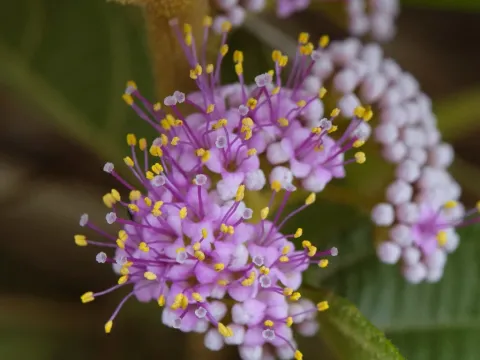
Beautyberry
Callicarpa L.
Beautyberry (genus Callicarpa L.) is a member of the Lamiaceae family, comprising several species of deciduous and evergreen shrubs. It is native to temperate and tropical regions of Asia, Australia, and North America, valued primarily for its showy, metallic-colored berries.
What the section contains
 Beautyberry
Callicarpa bodinieri H. Lev.
Beautyberry
Callicarpa bodinieri H. Lev.
 Beautyberry (C. dichotoma x C. kwangtungensis hybrid)
hybrids between Callicarpa dichotoma (Lour.) K. Koch and Callicarpa kwangtungensis Chun
Beautyberry (C. dichotoma x C. kwangtungensis hybrid)
hybrids between Callicarpa dichotoma (Lour.) K. Koch and Callicarpa kwangtungensis Chun
 Bodinier beautyberry
Callicarpa dichotoma (Lour.) K. Koch
Bodinier beautyberry
Callicarpa dichotoma (Lour.) K. Koch
 Japanese beautyberry
Callicarpa japonica Thunb.
Japanese beautyberry
Callicarpa japonica Thunb.
 Kwangtung beautyberry
Callicarpa kwangtungensis Chun
Kwangtung beautyberry
Callicarpa kwangtungensis Chun
Beautyberry
The plant thrives in full sun to partial shade. To achieve the best growth, provide a well-drained, fertile soil rich in organic matter. While it is adaptable to various soil types, maintaining consistent moisture is essential, especially for young plants during their establishment phase.
Regarding climate, beautyberry species like Callicarpa bodinieri show good cold tolerance. In northern areas, protecting the crown with mulch during winter is a recommended practice to ensure the shrub survives freezing temperatures and blooms effectively in the spring.
Agricultural management involves pruning in late winter or early spring before new growth appears. Since flowers and fruits form on new wood, hard pruning is often beneficial to keep the shrub compact and encourage a more prolific harvest of berries.
The primary use of Callicarpa is in landscaping as an ornamental shrub. Its ability to provide winter interest when leaves have dropped makes it a favorite for gardeners looking to provide food for wildlife and color to the dormant garden landscape.
Beautyberry is generally resilient, but it can be susceptible to leaf spot diseases. These are often caused by fungi that thrive in crowded conditions with poor air circulation, particularly during humid and wet summer seasons.
Pests such as aphids and spider mites can occasionally cause issues. Aphids cluster on new growth, causing leaf curling, while spider mites usually become a problem during hot, dry spells, leading to speckled or chlorotic foliage.
Scale insects may also attach themselves to the stems, sucking the sap and reducing the plant's overall vigor. Regular monitoring is the key to identifying these threats before they cause significant damage to the shrub's structure.
Management strategies focus on cultural practices first, such as proper spacing to ensure airflow. If an infestation occurs, horticultural oils or appropriate insecticides can be used to mitigate the impact of pests effectively.
Maintaining plant health through adequate nutrition and irrigation is the best defense against pests and diseases. A balanced fertilizer applied in early spring helps the beautyberry recover quickly from any environmental stressors it may encounter.