
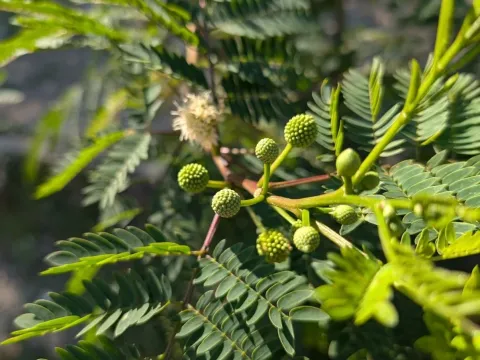
Leucaena
Leucaena
Leucaena is a genus of trees and shrubs in the Fabaceae (legume) family, widely recognized for its rapid growth and versatility. Native to the Americas, it has become a staple agricultural crop across tropical and subtropical regions for its environmental and economic benefits.
What the section contains

Leucaena
The plant thrives in warm, frost-free climates and is known for its remarkable drought tolerance. It is highly adapted to regions with long dry seasons, but it requires well-drained soils, as it is extremely sensitive to waterlogging and poor soil aeration.
Regarding soil health, Leucaena is a superior nitrogen-fixing legume that significantly enhances soil fertility. It can grow in various soil types, including alkaline and rocky substrates, though it shows the best biomass production in deep, fertile soils with a neutral pH.
Agrotechnical management primarily involves controlled establishment, where young saplings require protection from weeds until they develop a strong canopy. Once established, Leucaena is a robust crop that can tolerate repeated pruning and harvesting, making it suitable for sustainable management systems.
Economically, this crop is used for cattle forage rich in protein, as high-quality firewood, and as a natural fertilizer in agroforestry. It also provides essential ground cover to mitigate soil erosion on slopes.
The most significant pest affecting Leucaena plantations globally is the Leucaena psyllid (Heteropsylla cubana). This tiny insect causes severe damage by feeding on young foliage, which leads to defoliation and can devastate entire stands of the crop.
Diseases in Leucaena are typically linked to environmental stress, particularly fungal root rots caused by poor soil drainage. Additionally, leaf spot diseases can occur under conditions of high humidity, impacting the photosynthetic capacity of the plants.