
Guar
Cyamopsis tetragonoloba (L.) Taub.
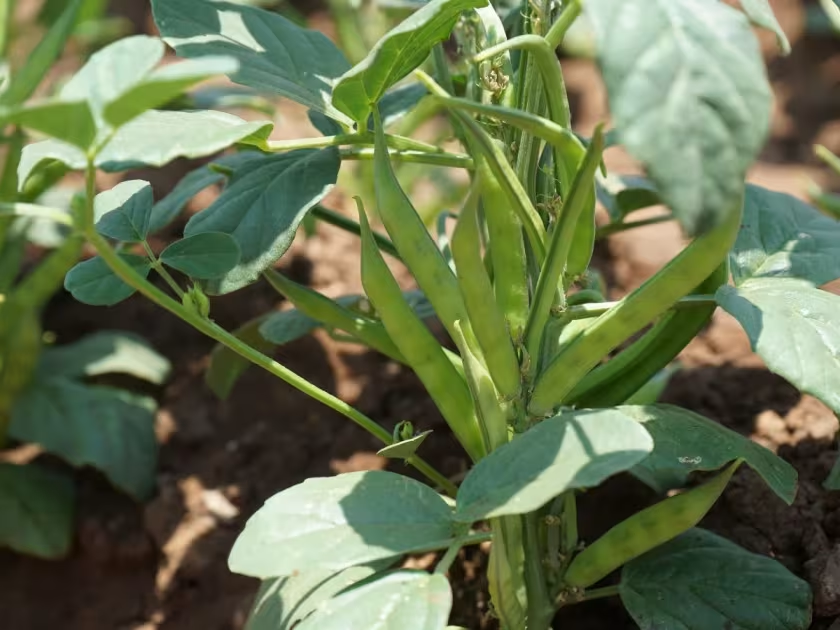
Description
Sowing dates
Guar is a heat-loving plant, so sowing must be carried out only after the soil temperature at planting depth has reached +20...+25°C.
Optimal sowing times fall during the period when stable summer temperatures are established, usually in May or early June depending on the climatic zone.
The seeding rate varies significantly depending on the production goal — whether for grain or green manure — ranging from 15 to 30 kg per hectare.
The seeds should be sown at a depth of 3–5 cm to ensure rapid germination under sufficient soil moisture conditions.
Row spacing for seed production is typically set between 45–60 cm to provide plants with adequate space for optimal growth and branching.
Growing requirements
Guar belongs to the Fabaceae family and is an extremely drought-tolerant crop capable of thriving in arid environments.
The crop prefers well-drained alluvial, sandy loam, or light loamy soils and does not tolerate waterlogging or high salinity levels.
The optimal pH range for successful guar production is between 7.0 and 8.5, making it well-suited for alkaline soils.
The plant possesses a deep taproot system, allowing it to efficiently extract moisture from lower soil profiles, which is critical in semi-arid regions.
Guar is highly heliophilic and requires intense solar radiation throughout the growing season to ensure proper fruit maturation.
Yield
The commercial yield of guar seed ranges from 800 to 1,500 kg per hectare under proper agronomic management practices.
When grown as a green manure or fodder crop, the biomass production can reach 20–25 tonnes per hectare in terms of fresh weight.
Economic use of guar is primarily driven by the production of guar gum, which is extracted from the seed endosperm and is highly valued in oil drilling and food industries.
A significant portion of global production is concentrated in India and Pakistan, where climatic conditions are most favorable for high crop yields.
Advances in cultivar development and breeding for stress tolerance allow farmers to increase profitability despite the plant's sensitivity to extreme temperature fluctuations.
Main diseases and pests
The main threats to guar crops include fungal diseases such as root rot and alternaria blight, which thrive in high-humidity conditions.
Among pests, aphids, cutworms, and certain types of weevils cause the most damage by affecting both the foliage and reproductive plant organs.
To minimize harvest loss, strict crop rotation is recommended, ensuring that guar is not planted on the same field more than once every 3–4 years.
The use of insecticides and fungicides must be strictly regulated, especially if the final product is intended for the food processing sector.
Weed competition during the early stages of development can significantly stunt guar growth, making timely inter-row cultivation essential.
Harvesting
Harvesting is performed at full maturity when the pods turn a distinct dark brown and the leaves yellow and shed.
It is crucial to avoid leaving the crop in the field for too long after maturity, as this can lead to pod shattering and substantial seed yield losses.
Modified grain combines with adjusted drum speeds are used for harvesting to minimize mechanical damage to the valuable seeds.
After threshing, the seeds require immediate drying to a moisture content of 10–12% to ensure long-term storage and quality during transport.
Plant residues (guar straw) remaining after seed harvest can be utilized as livestock feed, as they retain significant nutritional value.