
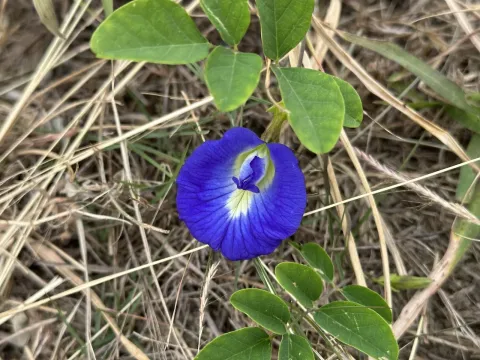
Clitoria
Clitoria
Clitoria ternatea is a thermophilic crop, therefore sowing in open fields is only possible after the soil has warmed up to 20-25 degrees Celsius.
What the section contains

Clitoria
In regions with temperate climates, it is recommended to start seedlings in greenhouses or cold frames 4-6 weeks before the expected planting date.
Seeds of the crop have a hard seed coat, so scarification or soaking in warm water for twenty-four hours is recommended to accelerate germination.
The planting depth for seeds is 1-2 centimeters, and it is crucial to maintain stable soil moisture until the emergence of the first true leaves.
The optimal planting density for commercial cultivation involves spacing plants 30-40 centimeters apart in rows to ensure adequate airflow and sunlight exposure.
Clitoria belongs to the Fabaceae family and thrives in well-drained, fertile loamy or sandy loam soils with a neutral pH level.
The crop is extremely sensitive to low temperatures and cannot withstand frost, requiring a stable climate with temperatures ranging from 20 to 30 degrees.
It is a light-demanding plant, so maximum productivity requires full sun exposure without shading from other taller crops or structures.
Regular irrigation is critical during the active vegetative growth phase, although the plant can temporarily tolerate drought due to its deep taproot system.
Since Clitoria is a nitrogen-fixing legume, it does not require heavy nitrogen fertilization, performing better with phosphorus and potassium-based supplements.
The primary threats to young Clitoria stands include soil-borne pests like wireworms and white grubs, which can cause significant damage to the root system.
Under conditions of high humidity and poor air circulation, plants may develop powdery mildew, leading to premature yellowing and leaf abscission.
Spider mite infestations during hot, dry weather are a serious concern, necessitating prompt treatment with biological agents to protect the foliage.
Improper irrigation management often triggers the onset of root rot, which spreads rapidly, especially in heavy or waterlogged clay soils.
Aphids can colonize young shoots and flower buds, sucking sap and acting as vectors for viral diseases that drastically reduce total farm yield.
Harvesting of Clitoria flowers is performed daily in the early morning hours, just as the buds begin to open, to ensure the highest concentration of active compounds.
After harvesting, the raw material must be dried immediately in a shaded, well-ventilated area or in specialized dehydrators at temperatures not exceeding 45 degrees.
If the goal of cultivation is seed production, pods should be harvested only after they have turned brown and dried completely on the vines.
The root system of the plant is sometimes harvested for medicinal purposes, involving careful extraction from the soil at the end of the growing season.
Gentle handling during the harvest process is mandatory, as the delicate petals are prone to bruising, which reduces their quality for the food and beverage industry.