
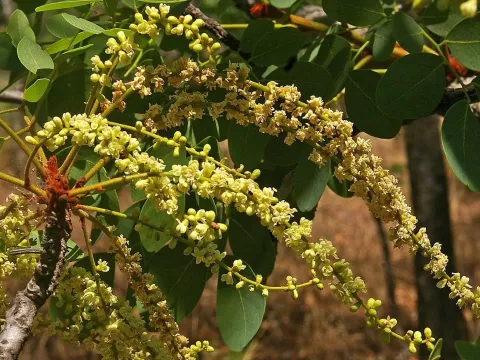
Burkea
Burkea
Burkea, primarily known through the species Burkea africana, is a leguminous tree species (Fabaceae) native to the savanna regions of tropical Africa. It is well-adapted to harsh environmental conditions and has historically played a vital role in local ecology.
What the section contains

Burkea
The tree reaches a height of up to 20 meters, exhibiting a spreading canopy and distinctive, compound leaves that often appear silvery due to dense hairiness. This feature is a key adaptation for minimizing water loss in high-temperature environments.
Burkea thrives in regions characterized by well-drained sandy or rocky soils. It is notably drought-tolerant, capable of surviving through long dry seasons where other vegetation might struggle, thanks to its deep root architecture.
Cultivation requires full sun exposure. In managed agroforestry systems, the tree is highly valued for its nitrogen-fixing capabilities, which contribute to soil fertility enrichment and support the growth of surrounding crops.
The timber of Burkea is commercially significant, prized for its extreme hardness, durability, and natural resistance to termites. Additionally, various parts of the tree are utilized in traditional medicine to address inflammatory conditions.
The primary threats to Burkea include various wood-boring beetles that can compromise the structural integrity of the timber if the trees are not properly maintained or harvested at the right time.
Fungal infections of the root system often occur if the soil remains waterlogged for extended periods. Ensuring proper drainage is the most effective management strategy to mitigate these risks in agricultural settings.
Defoliating insects, including several moth larvae species, can occasionally cause extensive damage to the canopy, particularly during the early stages of the rainy season when leaf flush is most vigorous.
Grazing animals represent a significant threat to saplings. Protection via fencing or physical barriers is essential until the trees reach a height where they are no longer accessible to large herbivores.
Effective management involves regular field monitoring, the removal of infected plant materials, and strategic spacing of trees to minimize the spread of pests and disease across a plantation.