
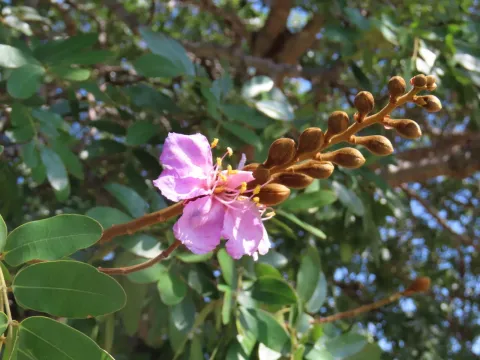
Baikiaea
Baikiaea
Baikiaea (Baikiaea plurijuga) belongs to the Fabaceae family and is known for its slow-growing habit and significant ecological value in its native habitats.
What the section contains


Baikiaea
Propagation is primarily done via seeds, which require proper scarification to overcome their hard coat and improve germination rates in nursery conditions.
The timing of sowing is crucial and should align with the onset of the rainy season to provide the necessary moisture for the establishment of the taproot.
In forest nurseries, seeds are typically planted in well-drained containers with a light, friable substrate to prevent root rot and ensure ease of transplanting.
Providing light shade for seedlings during their initial development stages is essential to prevent heat stress and desiccation in exposed nursery sites.
This species thrives in tropical regions characterized by a distinct seasonal cycle of rainfall, commonly found across Southern African woodlands.
Deep, well-drained sandy to loamy soils are ideal for Baikiaea, as the species requires substantial root space and is highly sensitive to waterlogged conditions.
The tree exhibits remarkable resilience to seasonal drought, a trait that allows it to survive in environments where water availability is highly variable.
As a light-demanding species, Baikiaea requires full sun exposure to reach its physiological potential and develop a robust canopy as it matures.
While tolerant of low soil nutrient levels, its growth rate is positively correlated with the presence of organic matter in the surface soil layers.
The primary yield of Baikiaea is its high-density timber, widely known as Zambezi teak, which is highly prized for its durability and aesthetic appeal.
Due to the species' slow growth rate, commercial yields are only realized over long time horizons, necessitating a focus on sustainable forest management.
Management practices, such as thinning, are employed to minimize resource competition and promote the development of clear, high-quality timber boles.
Yield estimation takes into account the long rotation age, as harvesting occurs decades after initial establishment, making it a long-term investment.
Sustainable silvicultural interventions are designed to maximize wood volume per hectare while maintaining the ecological integrity of the forest ecosystem.
Wildfires pose a significant threat to young Baikiaea stands, often destroying natural regeneration in the dry season when vegetation becomes highly flammable.
Pests and herbivores can severely impact the success rate of young plantations by damaging the bark and terminal buds of developing saplings.
Root pathogens may become an issue in areas with improper drainage or when soil compaction inhibits proper aeration and water movement.
Overgrazing by domestic livestock in forest areas prevents the natural recruitment of young trees, threatening the long-term age structure of the population.
Habitat fragmentation and land-use changes continue to be the primary drivers of population decline, limiting the ability of the species to naturally colonize.