
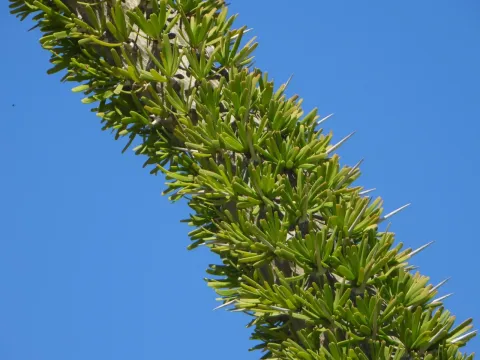
Didierea
Didierea
Didierea is a genus of succulent trees and shrubs native to the arid regions of Madagascar, belonging to the Didiereaceae family. These plants are uniquely adapted to harsh environments, characterized by their columnar, spine-covered stems that store water to survive prolonged droughts.
What the section contains


Didierea
The primary cultivation requirement for Didierea is high light intensity. Being a xerophyte, it requires full sun exposure throughout the day to maintain its structural integrity and ensure the development of its distinctive, dense, and thorny branches.
The growing medium must be highly porous and inorganic-heavy to ensure rapid drainage. A mix of pumice, coarse perlite, and a small amount of grit or sandy soil is recommended to prevent water accumulation near the base of the plant, which is lethal.
Temperature management is crucial: Didierea thrives in warm conditions, with an optimal range of 20°C to 30°C. During the winter dormancy period, the plant must be kept in a cool, dry place to prevent etiolation and stress, ideally at temperatures between 10°C and 15°C.
Watering frequency should be strictly monitored based on the plant's seasonal cycle. During the active growth season, water should be applied only after the substrate has completely dried out; in winter, water should be withheld almost entirely to mimic natural habitat conditions.
The most significant threat to Didierea is overwatering, which quickly leads to root rot and base stem necrosis. Once rot sets in, it spreads rapidly throughout the succulent tissue, often resulting in the total loss of the specimen.
Mealybugs are the most common pest infestation, often congregating in the dense clusters of spines where they are difficult to reach with standard surface treatments. Systemic insecticides are often required to manage persistent outbreaks.
Scale insects can attach themselves to the stems, causing localized yellowing and weakening of the plant structure. Removal with a soft brush dipped in alcohol is an effective control method for minor infestations.
Poor ventilation combined with high humidity can promote fungal infections that cause dark, sunken spots on the epidermis. Ensuring consistent airflow around the plant is a critical preventive measure.
Root damage caused by improper substrate compaction can invite pathogens that weaken the plant's natural defenses, making it susceptible to secondary infections and stunted growth.