
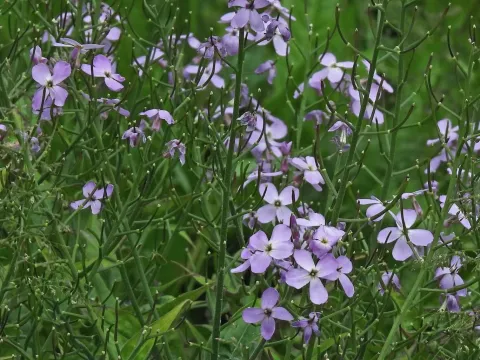
Hesperis
Hesperis
Sowing Hesperis is mainly carried out in autumn before winter or in early spring, as soon as the soil warms up to 5–8 degrees Celsius. The seeds have good germination rates but require mandatory stratification during winter sowing to ensure uniformity.
What the section contains

Hesperis
To obtain even shoots, seeds are sown at a depth of no more than 1–2 centimeters. It is important to follow the planting scheme, leaving row spacing of 30–45 centimeters, which provides an optimal feeding area for each plant.
In industrial farming conditions, it is recommended to use row sowing, which ensures an even distribution of seeds over the field. A high plant density contributes to suppressing weed growth during the initial stages of development.
During spring sowing, it is critical to ensure a sufficient level of soil moisture, as Hesperis seedlings are sensitive to the drying of the topsoil. In dry weather, light mulching is recommended to preserve moisture.
The optimal seeding rate is calculated based on the purity and germination of the specific seed batch. Usually, it ranges from 3 to 5 kilograms per hectare when using row sowing methods.
Hesperis belongs to the Brassicaceae family and prefers fertile loamy or sandy loam soils with a neutral pH. The crop does not tolerate stagnant moisture, so fields with high groundwater levels are not suitable for cultivation.
The plant is moderately demanding in terms of climate and exhibits high winter hardiness in temperate regions. It successfully adapts to temperature fluctuations and withstands spring frosts without significant damage to the growing point.
For full development, the crop requires sufficient light, although it can tolerate short-term shading. In partial shade, growth rates slow down, and the content of valuable oils in the seeds may slightly decrease.
Crop maintenance consists of regular inter-row loosening to improve soil aeration. The application of mineral fertilizers, especially nitrogen at the beginning of the growing season, promotes intensive vegetative growth.
The crop shows a high response to organic fertilization, which positively affects the yield of oilseeds. It is important to avoid excessive nitrogen accumulation before the flowering phase to prevent stem lodging.
The main threat to Hesperis is the cruciferous flea beetle, which can completely destroy young seedlings during the cotyledon stage. To combat them, timely insecticidal treatment of crops is applied once the economic threshold is reached.
Among fungal diseases, clubroot is the most common, especially in soils with high acidity. Prevention consists of crop rotation and liming the soil before sowing the crop.
Under conditions of excessive humidity, downy mildew (peronosporosis) may occur. At the first signs of the disease, systemic fungicides approved for technical crops should be applied.
Aphids can cause damage during the budding period by sucking juices from young leaves and flowers. This leads to deformation of plant organs and reduced harvest quality, making pest monitoring an essential element of agronomy.
For crop protection, an integrated system is recommended, including agronomic methods and the use of biopesticides. This significantly reduces the pesticide load on the surrounding environment.
Harvesting Hesperis for seeds begins when most of the pods turn brown, indicating physiological maturity. It is important not to allow over-ripening, as this leads to pod shattering and significant seed losses.
A two-stage harvesting method is commonly used: first, the crop is mowed into windrows for drying, and then threshed with combine harvesters. This allows for obtaining seeds with minimal moisture and reduces harvest losses.
The harvested seed material needs immediate cleaning from impurities and drying to a moisture content of 8–10 percent to ensure long-term storage. Seeds should be kept in dry, well-ventilated rooms in appropriate bags.
Hesperis seeds contain valuable fatty oil used in technical industries and cosmetics. Due to its high erucic acid content, the product finds applications in the production of biodiesel and lubricants.
Hesperis is also of interest as a honey-producing crop. During mass flowering, the fields attract a large number of pollinators, which contributes to higher seed set and increased overall crop productivity.