
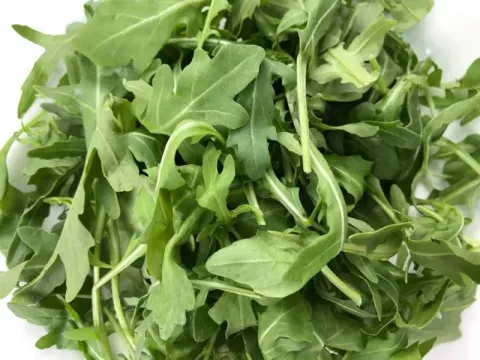
Arugula
Eruca
Eruca sativa, commonly known as arugula or rocket, is a fast-growing annual herb that allows for multiple harvests throughout the growing season. Planting generally begins in early spring, as soon as the soil can be worked, as the plant thrives in cooler temperatures.
What the section contains

Arugula
To ensure a continuous supply of fresh greens, it is recommended to sow seeds in succession every two to three weeks. In regions with long, hot summers, spring and late summer sowings are most successful, as excessive daylight and heat often trigger premature bolting.
For growers using greenhouse systems, arugula can be sown as early as late winter with the aid of supplemental lighting. This practice provides early-season produce when outdoor growing conditions are not yet optimal for plant growth and development.
Seeds should be sown at a depth of approximately 0.5 to 1 cm, requiring consistent moisture to ensure uniform germination. Proper seed-to-soil contact is essential for establishing a healthy root system during the initial stages of seedling development.
The planting density depends on the desired leaf size; for commercial baby leaf production, higher densities are often used. Proper spacing is crucial to prevent the microclimate from becoming too humid, which can lead to various fungal pathogens within the canopy.
As a member of the Brassicaceae family, arugula prefers well-drained, fertile soil rich in organic matter. A neutral to slightly alkaline soil pH is optimal for nutrient uptake and overall plant vigor, ensuring high-quality leaf production.
Arugula is a light-loving plant but is highly sensitive to the length of the day. Exposure to long days often leads to early flowering, which negatively impacts leaf quality; therefore, shading during the peak of summer is a common strategy to extend the harvest window.
Adequate soil moisture is vital for maintaining the characteristic peppery flavor and tender texture of the leaves. Water stress not only inhibits growth but also causes the leaves to develop a tougher texture and an excessively pungent taste that is often undesirable to consumers.
The plant grows best in temperatures between 15 and 20 degrees Celsius. While it is tolerant of light frost, growth slows significantly in cold weather, and high heat stress can cause rapid maturation and bolting, limiting the marketability of the produce.
Soil fertility management should focus on balanced organic input during the land preparation phase. Excess nitrogen applications, especially shortly before harvest, should be avoided to prevent nitrate accumulation in the leaves, which is a key quality and safety standard.
The yield potential of arugula typically ranges from 1.5 to 2.5 kilograms per square meter, depending on the variety, soil conditions, and management practices. High-yield production is achievable through consistent irrigation and optimized plant density management.
The rapid life cycle of the crop, spanning from 20 to 35 days, allows for highly efficient land use. In many climates, this cycle enables growers to produce up to four crops per season, making it a very profitable leafy vegetable choice for market gardeners.
To maximize yields, timely thinning of seedlings is necessary to provide adequate space for individual plants to develop full, healthy rosettes. A well-spaced plant produces larger, more uniform leaves that meet commercial quality standards much more effectively.
Modern hybrid varieties are specifically bred for improved uniformity and resistance to early bolting, which contributes significantly to higher marketable yields. Choosing the right cultivar for the specific season is a key factor in successful agricultural production.
Post-harvest handling is critical for maintaining yield value, as arugula leaves are highly perishable. Proper temperature management, specifically precooling, helps maintain leaf turgor and minimizes product loss due to wilting or physiological degradation after harvesting.
The most significant threat to arugula production is the flea beetle, which causes characteristic "shothole" damage to leaves. Floating row covers are often the most effective method for excluding these pests during the early establishment phase of the crop.
Downy mildew is a common fungal disease, especially in conditions with high humidity and poor air circulation. Management strategies include selecting resistant varieties, maintaining optimal spacing, and ensuring that foliage remains dry, particularly during evening hours.
Slugs and snails can also pose a serious problem in damp, shaded environments, feeding on the succulent leaves. Integrated pest management, including physical barriers and trapping, can effectively mitigate these threats without the need for intensive pesticide use.
Clubroot, a soil-borne disease of Brassicaceae, can cause severe stunting and plant death if the crop is planted in infested soil. Avoiding continuous cropping of brassicas on the same land is essential for preventing the buildup of soil-borne pathogens and ensuring long-term soil health.
- Flea beetles
- Downy mildew
- Clubroot
- Slugs and snails
- Caterpillars
Harvesting usually commences when the leaves reach a height of 10 to 15 centimeters. It is crucial to perform the harvest before the flower stalk begins to emerge, as the transition to the reproductive stage significantly lowers leaf quality and palatability.
Harvesting is typically done by cutting the leaf rosettes at a height of 2–3 centimeters above the soil line. Some growers use a cut-and-come-again method, selectively harvesting individual outer leaves, which allows the central heart of the plant to continue producing new foliage.
For the best quality and shelf life, harvest should be performed early in the day when leaves are cool and fully turgid. Avoiding harvesting during the heat of the day reduces the moisture loss that can occur when the plant is under temperature stress.
Immediately after harvest, the arugula should be shaded and moved to a refrigerated environment to stop the physiological processes that lead to rapid degradation. Proper storage temperatures of 2–4 degrees Celsius significantly extend the shelf life of the final product.
Post-harvest sorting is essential to remove any damaged or yellowed leaves, ensuring a uniform and high-quality final product. Packaging should ideally allow for some respiration to prevent the build-up of moisture, which can cause rotting during transport and retail.