
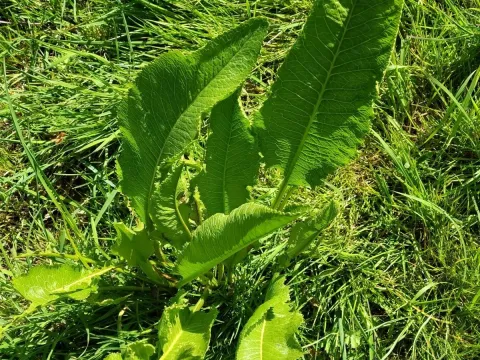
Horseradish
Armoracia Gaertn., Mey. et Scherb.
Horseradish (Armoracia rusticana) is a perennial crop belonging to the Brassicaceae family. Propagation is strictly vegetative, typically using root cuttings 15–20 cm in length. Planting is carried out in early spring as soon as the soil warms up to at least 5-8 degrees Celsius.
What the section contains

Horseradish
For planting material, side roots harvested from the previous season are selected. To ensure the formation of a strong, single taproot, growers often remove buds from the middle section of the cutting, leaving only those at the top and bottom ends.
The recommended planting pattern involves 60–70 cm spacing between rows and 30 cm between plants. Cuttings are usually placed in furrows at a 45-degree angle, with the upper end covered by 5–7 cm of soil to facilitate optimal rooting.
Fall planting is also an option, performed 2–3 weeks before the first hard frosts. Horseradish is exceptionally winter-hardy and requires no extra protection during the dormant season, even in colder northern climates.
While horseradish can remain in the same spot for several years, professional growers usually refresh the crop every 1–2 years to maintain root quality and prevent the spread of soil-borne diseases within the plot.
Horseradish thrives in deep, fertile, and loose sandy loam or silty loam soils. Compact or stony soils should be avoided, as they inhibit root development and cause the formation of branched or deformed roots that are less commercially desirable.
Adequate moisture is critical for success, particularly during the peak growing season. While the plant is quite resilient, prolonged drought can lead to woody roots and a diminished pungent flavor profile, necessitating irrigation in dry climates.
Choose an open, sunny location for the best growth, though the crop can tolerate partial shade. Proper drainage is essential; waterlogged conditions, especially during the dormant season, will quickly lead to root rot and loss of yield.
Soil should be enriched with organic matter, such as compost or well-rotted manure, at a rate of 3–5 kg per square meter prior to planting. A neutral pH range of 6.0 to 7.0 is ideal, and liming is recommended for acidic soils.
Regular weeding and inter-row cultivation during the early stages of development help maintain soil aeration. Once the large, leafy canopy is established, it often shades out most competing weeds, reducing the need for constant maintenance.
Yields of horseradish vary significantly depending on soil fertility and management practices. With proper intensive care, a well-managed hectare can produce between 15 to 25 tons of raw root material per season.
To improve market quality, growers often perform a practice known as "root rubbing" in mid-summer. The soil is carefully pulled away from the crown, and secondary side roots are removed or rubbed off to encourage the energy into a single, smooth, thick main root.
Harvestable root mass continues to accumulate until late autumn. The plant's pungent flavor and essential oil content peak after the first light frosts, making late autumn the best time to realize the highest quality output.
Flowering, if it occurs in the first year, should be suppressed by removing flower stalks promptly. This redirects the plant's metabolic energy toward root thickening rather than reproductive growth, effectively increasing the final weight of the harvest.
Varietal selection plays a role in yield potential; modern cultivars are bred for uniformity, root diameter, and disease resistance, providing a more reliable return on investment for farmers focusing on commercial production.
White rust (Albugo candida) is a common fungal disease that manifests as white pustules on the leaves. Strict crop rotation is the primary defense, as this disease easily infects other related members of the Brassicaceae family.
Bacterial soft rot can cause severe damage, especially during storage. To prevent this, growers must ensure that roots are harvested without bruising and are stored in well-ventilated conditions at low temperatures to inhibit bacterial growth.
Crucifer flea beetles are the most frequent insect pests, often attacking young foliage in the spring. Small-scale farmers often rely on row covers or early-season biological insecticides to protect the plant's initial leaf development.
Horseradish leaf beetles can also defoliate the plant during the growing season. Integrated pest management (IPM) practices, including the removal of crop residues and maintaining clean fields, are essential to keep these populations under control.
Managing the surrounding area for weeds that host similar diseases is a critical prophylactic measure. Removing wild mustard and other related cruciferous weeds around the farm significantly reduces the pressure from both insects and fungi.
Harvesting is typically performed from October to November. The use of specialized equipment or sturdy garden forks is necessary to lift the roots from the soil, as they can grow quite deep, sometimes exceeding 50–60 cm.
After removal, roots should be washed and trimmed. The main roots are sorted for sale, while small, healthy side roots are set aside for the next season's propagation. Proper sorting ensures that only top-quality material reaches the market.
For storage, roots are kept in cool, dark, and humid environments, often buried in sand in cellars at temperatures near 0–2 degrees Celsius. This method keeps the roots crisp, pungent, and prevents them from drying out throughout the winter.
Horseradish is highly valued in the food industry for its strong antibacterial properties, derived from allyl isothiocyanate. It is widely used in condiments, pickles, and culinary preparations to enhance flavor and serve as a natural preservative.
A high-quality harvest is characterized by firm, white-fleshed roots that exhibit a strong, characteristic aroma when cut. Any sign of internal hollowing or discoloration indicates poor storage or damage and should be discarded before processing.