
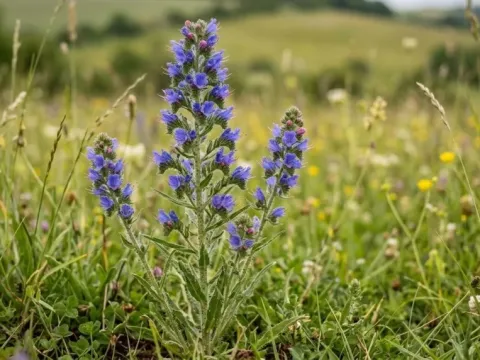
Blueweed
Pontechium
Blueweed (Pontechium maculatum), a member of the Boraginaceae family, is a biennial plant often utilized for its exceptional nectar production. Sowing is typically performed in early spring or late autumn, depending on local climatic conditions and soil temperature.
What the section contains

Blueweed
The recommended seeding rate is approximately 4–6 kg per hectare. Seeds should be sown at a shallow depth of 1–2 cm to ensure optimal germination, as they require sufficient contact with moist soil while remaining close to the surface for light exposure.
During its first year, the plant develops a robust basal rosette and an extensive root system. This stage is crucial for establishing a healthy crop, and fields should be kept free of weeds to allow the plants to develop fully without intense competition.
Once the rows close, the crop becomes highly competitive and capable of suppressing most weeds on its own. This reduces the need for extensive herbicide application, making it a sustainable choice for many agricultural operations.
Reliable establishment is key to long-term success. Properly sown crops demonstrate high vitality and vigor, which contributes to increased nectar flow during the plant's second year of growth.
Blueweed is highly drought-tolerant, making it an excellent candidate for regions with arid climates or limited water resources. It thrives in well-lit areas and performs poorly when shaded by trees or taller crops.
The plant is not overly demanding regarding soil type; it performs best in sandy loam, chernozem, or light clay soils. It avoids poorly drained or overly acidic soils, preferring neutral or slightly alkaline environments.
Agrotechnical practices focus on early weeding and maintaining soil structure through light cultivation. Potassium and phosphorus fertilizers can enhance the root development, leading to stronger plants and more reliable flowering cycles.
Climate plays a critical role in the plant's nectar secretion. Warm and dry weather during the blooming phase is essential for maximizing honey production, as high humidity can reduce the concentration of sugars in the nectar.
The plant is remarkably winter-hardy and capable of enduring severe cold provided there is an adequate layer of snow. Its ability to adapt to varying temperatures ensures high survival rates across different agricultural landscapes.
The primary use of Blueweed is in beekeeping, where it is highly valued as a top-tier honey plant. Under ideal conditions and with high plant density, it can yield 300–500 kg of honey per hectare, offering significant economic value.
As a forage crop, it is less common but can be included in animal diets if harvested before full maturity. Its protein content makes it a useful supplement when properly integrated into feed mixes with other forage grasses.
Biological production of green biomass can reach 20–30 tons per hectare. Harvesting for biomass is most effective during the budding stage, ensuring that the stems are not yet woody and maintain higher nutrient profiles for livestock.
Blueweed serves as an excellent phytoremediation and soil-improving agent. Its deep taproots help loosen compacted soil layers and prevent erosion, providing long-term benefits to the structural integrity of the field.
The plant's ability to self-seed means that fields can remain productive for several years without the need for constant reseeding. This natural regeneration provides a low-maintenance solution for apiculturists and farmers alike.
Blueweed is generally resistant to most common agricultural diseases, although powdery mildew can occur in areas with poor airflow and high humidity. Proper crop spacing is the best preventative measure against such outbreaks.
Pests rarely cause significant economic damage, but aphids may occasionally colonize the plants during the flowering season. Control measures are rarely needed and should focus on biological balance rather than aggressive chemical treatment.
Maintaining a healthy crop rotation cycle is essential to prevent soil-borne pathogens. By providing optimal growing conditions, the plants can maintain their natural immunity and withstand minor stressors effectively.
Monitoring the crop for signs of stress is important during the active growing season. Removing infected individuals early can stop the spread of potential fungal infections and ensure the health of the entire field.
Pollinator safety is a major priority; therefore, all protective measures must be strictly non-toxic to honeybees. Sustainable farming practices are encouraged to ensure the longevity of the honey-producing potential of the field.
Harvesting seeds requires careful timing, as the plant matures unevenly from the bottom of the flower spike upwards. The ideal time to begin is when the majority of the seeds have turned a deep brown color.
Direct combining is the standard method for harvesting. Speed and header adjustment are critical, as the seeds can be prone to shattering in dry conditions, leading to potential yield losses if the machinery is too aggressive.
Post-harvest, the seeds must be dried and cleaned immediately to prevent moisture-related damage. Proper storage involves keeping the seeds in a cool, ventilated environment to preserve their viability for future seasons.
Green forage harvesting involves standard mowing equipment. It is important to harvest before the plant turns woody, as mature stems are difficult for livestock to consume and offer lower overall feed value.
Stored seeds remain viable for several years if kept dry and away from direct sunlight. This long shelf life allows farmers to manage their planting schedule efficiently based on market demand and rotational needs.