
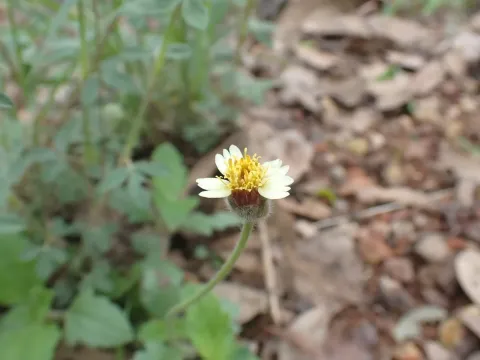
Tridax
Tridax
Tridax (genus Tridax) is a herbaceous plant belonging to the Asteraceae family. In an agricultural context, it is often considered a weed, but it is actively studied in tropical regions for its significant medicinal properties.
What the section contains

Tridax
The seeds of Tridax exhibit high germination rates and self-seeding capabilities, making it a highly invasive species in agricultural fields. Optimal sowing conditions occur when soil temperatures stabilize between 20 and 25 degrees Celsius.
The plant shows remarkable resilience across various soil types, including sandy, clay, and degraded soils. Agricultural control measures often require early intervention because Tridax reaches its reproductive phase very quickly.
When grown for specialized purposes, such as pharmacological research, sowing is performed in a prepared substrate, ensuring adequate spacing between rows to manage its root spread.
The plant's lifecycle allows for year-round flowering in tropical climates, rendering sowing dates secondary compared to the constant availability of moisture and sunlight.
Tridax prefers sunny, open areas with minimal shade, reflecting its origin in the tropical regions of Central and South America. High light intensity is a critical factor for the accumulation of active biological compounds.
Regarding soil conditions, Tridax is undemanding, though it thrives best in well-drained, slightly acidic, or neutral soils with moderate nutrient content.
The plant demonstrates high drought resistance due to a well-developed root system, allowing it to survive under irregular irrigation regimes.
The temperature optimum for growth ranges from 22 to 30 degrees Celsius. The plant is poorly adapted to frosts and sudden drops in nighttime temperatures below 10 degrees.
For industrial cultivation, regular weeding or inter-row cultivation is recommended to improve soil aeration and suppress competing weed species.
Since Tridax is predominantly classified as a weed, the term "yield" is rarely used in a standard agrarian sense. However, in medicinal applications, the biomass of the above-ground parts is highly valued.
Under controlled cultivation, the dry matter yield can reach significant levels due to the plant's rapid growth rate and its ability to recover after multiple harvests.
A single plant can produce thousands of seeds, ensuring high reproductive capacity and natural population regeneration.
Limiting factors for harvesting include potential parasitic infections and competition with other fast-growing species for resources.
To maximize the yield of beneficial compounds, it is recommended to harvest the raw material during the peak flowering stage, when the concentration of secondary metabolites is highest.
Tridax possesses a high natural resistance to most pests, which is attributed to the presence of specific chemical compounds within its tissues.
The primary threats include powdery mildew, which can develop under conditions of high air humidity and poor wind circulation within the plant canopy.
Young seedlings may be susceptible to soil-borne pests, such as wireworms or mole crickets, during the germination and establishment phases.
- Powdery mildew (Erysiphaceae).
- Root rot (Pythium spp.).
- Aphids (Aphididae) — in high-density plantings.
- Nematodes — when grown on infested sites.
To control diseases, it is recommended to follow proper crop rotation practices and apply fungicides at early stages of vegetative growth if signs of infection appear.
Harvesting of the above-ground biomass is primarily carried out manually or using mechanical mowers during the plant's peak flowering period.
The harvested material requires immediate drying in well-ventilated areas to prevent mold growth and preserve the biological activity of the components.
When used as medicinal raw material, it is crucial to avoid soil contamination; therefore, cutting should be performed 5–10 cm above the soil surface.
After the harvest, remaining root systems should be removed if the field needs to be prepared for subsequent crops in a rotation cycle.
Storage of the dried raw material should be done in airtight containers in a cool, dark place to prevent degradation of active compounds by ultraviolet light.