
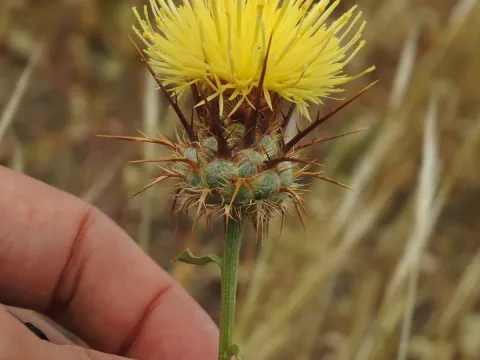
Centaurea ornata
Centaurea ornata
Centaurea ornata, commonly referred to as the ornate knapweed, belongs to the Asteraceae family. It is a striking herbaceous species native to the Iberian Peninsula and parts of North Africa. In agricultural contexts, it is primarily cultivated for its decorative value and potential as a melliferous crop.
What the section contains
Centaurea ornata
The sowing season typically begins in early spring, once the soil temperatures stabilize above 10 degrees Celsius. Seeds are sown at a shallow depth of approximately 1-2 centimeters. When planted in rows, a spacing of 30-40 centimeters is recommended to ensure each plant receives adequate ventilation and light.
For indoor propagation, seeds can be started in seedling trays during late winter. Transplanting to the permanent outdoor site should only occur after the danger of frost has passed, as young seedlings are sensitive to low temperatures, even though the mature plant is notably hardy and drought-tolerant.
The botanical characteristics of this species include a deep, robust taproot and long, lance-shaped leaves that form a dense basal rosette. This structure allows the plant to thrive in dry, rocky soils where other species might struggle, reflecting its Mediterranean evolutionary origins and adaptation to xeric environments.
Choosing an appropriate location is critical for success. The site must be well-drained and open to direct sunlight throughout the entire day. Any accumulation of stagnant water near the root zone during the seedling phase can significantly hamper development and increase the risk of decay.
High light intensity is the primary requirement for Centaurea ornata. It is an obligate sun-loving species; growing it in shaded conditions results in elongated, weak stems and significantly reduced flowering. Adequate spacing is essential to prevent self-shading among plants within the same plot.
Soil composition should ideally be sandy or loamy with a neutral to slightly alkaline pH. The plant performs poorly in heavy, waterlogged soils. Agronomists often recommend amending clay-heavy sites with coarse sand or fine gravel to improve drainage and aeration, which are essential for the health of the taproot.
The temperature regime suitable for this culture ranges from 15 to 25 degrees Celsius. While it can withstand occasional heat waves, extreme summer temperatures accompanied by high humidity can lead to physiological stress. Therefore, proper site selection and airflow management are vital for large-scale production.
Irrigation management is relatively simple for this species once it is established. In the initial growth phase, consistent moisture is necessary, but as the plant matures, it becomes exceptionally drought-resistant. Over-watering is a common mistake that leads to root rot and diminished vigor.
Fertilization should be applied sparingly. Excessive nitrogen promotes vegetative growth at the expense of floral production. A balanced, slow-release fertilizer high in potassium and phosphorus is preferable to encourage root system strength and vibrant, long-lasting blossoms during the flowering season.
The most significant threats to Centaurea ornata are fungal pathogens, specifically powdery mildew and root rot. These issues often arise due to poor air circulation or excessive soil moisture. Preventive measures include wide planting spacing and the removal of any diseased plant tissue to limit spread.
Pests such as aphids and spider mites are frequent invaders. Aphids congregate on tender buds and leaves, causing distortion and sucking vital sap, while spider mites thrive in hot, dry weather. Both can be controlled with organic insecticidal soaps or systemic pesticides if the infestation becomes severe.
Weed competition is a major concern during the early establishment phase. As a relatively slow grower in the first few weeks, the plant can easily be outcompeted by aggressive weeds. Regular manual weeding or shallow mechanical cultivation between rows is necessary until the plant forms a mature canopy.
Crop rotation is a fundamental agronomic practice to manage soil-borne pathogens. Centaurea ornata should not be planted in the same area more than once every three to four years. This strategy helps break the lifecycle of specific soil-dwelling pests that target the Asteraceae family.
Sanitation after harvest plays a major role in integrated pest management. Removing all debris and ensuring the soil is cleared of dried plant matter significantly reduces the overwintering sites for insects and fungal spores, providing a cleaner start for the subsequent cropping cycle.