
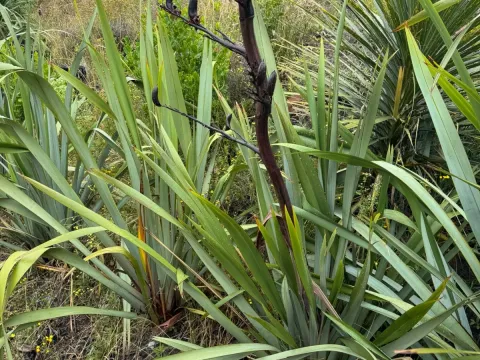
New Zealand flax
Phormium J.R. et G. Forst.
Propagation of Phormium is primarily achieved through division of the root clump, as seed germination is often slow and produces variable results. The ideal time for planting is during the spring when the soil has warmed up sufficiently to support root establishment.
What the section contains


New Zealand flax
If starting from seeds, they should be sown indoors in late winter. Maintaining a consistent temperature of around 20–22 degrees Celsius is essential for uniform germination and seedling vigor.
Seedlings are transplanted into the field once they have developed a robust root system and multiple leaves. Spacing is crucial, with at least 1–1.5 meters between plants to accommodate the spreading rhizomes.
Proper soil preparation, including deep plowing and thorough weed removal, is vital, as the initial growth phase of Phormium is relatively slow, leaving it vulnerable to weed competition.
On industrial plantations, a linear planting layout is preferred to facilitate mechanical maintenance and the logistics of harvesting the biomass.
Phormium belongs to the Asphodelaceae family and is native to New Zealand and Norfolk Island. It thrives in sunny locations, requiring ample light for healthy leaf production and fiber development.
The plant prefers fertile, loamy, and well-draining soils. While it is adaptable, it strictly avoids waterlogged conditions, which can quickly lead to root rot and other moisture-related diseases.
Though moderately cold-tolerant, it can only withstand brief frosts down to -5 degrees Celsius. In harsher climates, it must be grown in containers or provided with protective coverage during winter.
Wind protection is an important consideration, as strong winds can cause shredding of the long, sword-shaped leaves, thereby reducing the quality of the harvestable fiber.
Irrigation should be managed to keep the soil consistently moist but not saturated during the growing season, while keeping the plants drier during the dormant winter months.
The primary yield from Phormium is the strong, high-tensile fiber extracted from its long leaves. Productivity is significantly influenced by plantation age and the intensity of the fertilization program.
The quality of the fiber is highly dependent on nutrient availability; rich, fertile soil promotes longer, more elastic leaves which are highly prized for rope-making and textile production.
Harvest cycles are usually planned on a multi-year basis, with leaves reaching technical maturity after two to three years of steady growth.
Balanced nitrogen and potassium fertilization is employed in commercial setups to stimulate linear growth and increase the total yield of raw fiber per hectare.
Yield efficiency is measured not only by the weight of raw leaf biomass but also by the fiber extraction percentage, which varies depending on the specific cultivar used.
Phormium is generally resilient to pests, but poor management can lead to outbreaks of root rot or fungal infections under high-humidity conditions.
Common pests include scale insects and mealybugs, which congregate at the base of the leaves and extract plant sap, weakening the overall structure of the plant.
In indoor or greenhouse settings, spider mites can become a nuisance, causing the leaves to lose color and eventually dry out if left untreated.
Effective management strategies include the timely application of systemic insecticides and strict sanitation practices, such as removing and destroying infested plant material.
Prevention of bacterial diseases is best achieved by avoiding overhead watering, which prevents moisture from pooling in the plant's central rosette, where growth points are most vulnerable.
Harvesting involves the careful cutting of mature, outer leaves near the base of the plant, ensuring that the central fan or heart of the plant remains undamaged.
Preserving the growth center is essential for the plant's ability to regenerate and provide multiple harvests over its lifespan, which can last for many years.
Following harvest, the leaves undergo decortication—a process that scrapes away the fleshy outer tissue to expose the high-quality fibers inside.
The extracted fibers are then washed and sun-dried to ensure durability and prevent spoilage before being baled for transport or industrial use.
Storage requires a dry, well-ventilated environment to prevent mold growth and maintain the structural integrity of the fibers for later processing.