
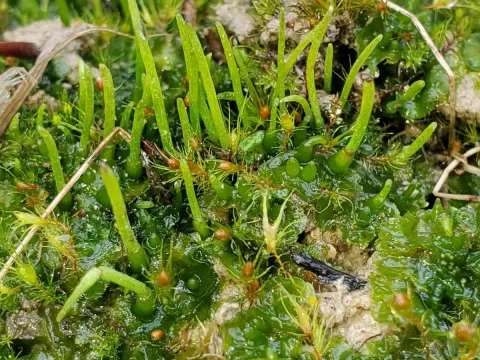
Phaeoceros carolinianus
Phaeoceros carolinianus
Phaeoceros carolinianus is a species of hornwort belonging to the family Anthocerotaceae. As a non-vascular plant, it holds a significant position in botanical studies, bridging the gap between primitive bryophytes and more complex vascular plant species.
What the section contains
Phaeoceros carolinianus
The plant has a cosmopolitan distribution, thriving in tropical and temperate regions across the globe. It is typically found in moist environments, such as damp clay soils, field margins, stream banks, and drainage ditches where high humidity is consistently maintained.
Specific environmental conditions are necessary for its development, primarily high soil moisture and air humidity. The plant lacks an efficient water-retention mechanism, making it highly susceptible to drought conditions, which restrict its growth to specific ecological niches.
A remarkable feature of Phaeoceros carolinianus is its symbiotic relationship with cyanobacteria of the genus Nostoc. These bacteria reside within the thallus cavities, fixing nitrogen for the plant and allowing it to flourish in nutrient-poor environments.
Morphologically, the plant consists of a rosette-shaped thallus and distinct, horn-like sporophytes. These sporophytes are characterized by basal meristem growth, which allows them to continue maturing over an extended period of time compared to typical mosses.
The primary threats to the survival of Phaeoceros carolinianus include large-scale land drainage and soil reclamation projects. Such human activities disrupt the natural water balance, leading to the rapid decline of localized populations that depend on surface moisture.
Additionally, agricultural runoff containing herbicides and fertilizers poses a significant risk. The chemical alteration of the soil acidity and composition disrupts the delicate symbiotic relationship with nitrogen-fixing cyanobacteria, ultimately threatening the plant's viability.