
Ceraria
Ceraria
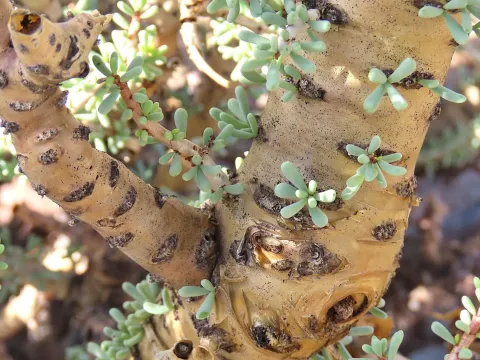
Ceraria is a genus of succulent plants within the Didiereaceae family, native to the arid regions of southern Africa, specifically thriving in Namibia and the Northern Cape. These plants are well-adapted to high-temperature environments and sparse rainfall.
What the section contains
Ceraria
The botanical structure of Ceraria features fleshy, drought-resistant foliage and thick, woody stems designed for water storage. These adaptations allow the plant to survive in environments where most other vegetation cannot endure the lack of sustained water sources.
Regarding climatic requirements, Ceraria demands high light intensity throughout the year. It is imperative to provide full sunlight exposure, as even partial shade can cause the plant to weaken and lose its characteristic compact form and health.
Soil composition must mimic the natural habitat, prioritizing drainage above all else. A mineral-heavy mix, comprising pumice, volcanic rock, or coarse sand, is essential to prevent moisture retention that could be fatal to the plant's delicate root system.
Cultural management focuses on strict seasonal watering intervals. During the warm growing season, watering should be thorough but infrequent, allowing the substrate to dry completely between applications. During winter dormancy, moisture should be almost entirely withheld.
The primary threat to the health of Ceraria is root rot caused by poor soil drainage and excessive humidity. This physiological stress makes the plant susceptible to secondary pathogens such as Pythium and Phytophthora species.
Mealybugs represent the most common biological pest threat, feeding on the plant's sap and often hiding in tight stem nodes. Infestations can spread quickly, leading to yellowing of leaves and structural decline of the plant.
Spider mites can also occur in environments with poor ventilation and low humidity levels. These pests cause visible damage to the leaf epidermis, which can reduce the plant's photosynthetic efficiency over time.
To mitigate these threats, growers should maintain adequate airflow around the plant and perform periodic inspections for pest clusters. Isolation of new or affected specimens is a standard practice to prevent the spread of diseases.
Chemical control should be employed only when mechanical methods fail, ensuring that chosen pesticides are compatible with succulent plant tissues to avoid phytotoxic damage during the treatment process.