
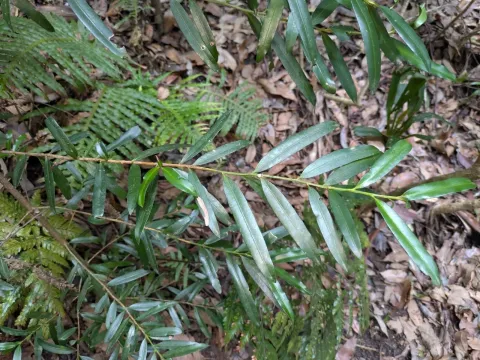
Podocarpus
Podocarpus L’Hérit. ex Pers.
Podocarpus (lat. Podocarpus) belongs to the Podocarpaceae family. It is an evergreen coniferous plant, presented as shrubs or trees, naturally occurring in tropical and subtropical regions of the Southern Hemisphere, including New Zealand, Japan, and parts of South America.
What the section contains
 Alpine totara
Podocarpus nivalis Hook.
Alpine totara
Podocarpus nivalis Hook.
 Hall's totara
Podocarpus cunninghamii Colenso
Hall's totara
Podocarpus cunninghamii Colenso
 Needle-leaved totara
Podocarpus acutifolius Kirk 1883
Needle-leaved totara
Podocarpus acutifolius Kirk 1883
 Podocarpus macrophyllus
 (Thunb.) D. Don
Podocarpus macrophyllus
Podocarpus macrophyllus (Thunb.) D. Don
 Podocarpus madagascariensis
 Baker
Podocarpus madagascariensis
Podocarpus madagascariensis Baker
 Podocarpus totara
 G. Benn. ex D. Don
Podocarpus totara
Podocarpus totara G. Benn. ex D. Don
Podocarpus
The culture has strict light requirements. For active growth, the plant needs bright but diffused light, as direct sunlight can cause leaf scorch. In greenhouse conditions, it is essential to maintain a stable temperature without drastic fluctuations to ensure the health of the plant.
Soil preferences for Podocarpus include well-drained substrates with a moderately acidic or neutral pH level. Waterlogging in the root system is fatal to the plant, therefore, installing a high-quality drainage layer made of expanded clay or gravel is mandatory during the planting process.
Climate conditions for this crop should be as close as possible to subtropical. The plant is frost-sensitive, so in temperate regions, it is mainly cultivated as a greenhouse or container plant, requiring relocation to indoor environments during the winter period.
Agronomic techniques involve regular but moderate irrigation, allowing the top layer of soil to dry out between waterings. Air humidity plays a crucial role: when kept in dry indoor environments, Podocarpus requires regular misting or the use of humidifiers to maintain needle turgor.
The main pests affecting Podocarpus are scale insects and mealybugs. These insects feed on cell sap, leading to plant weakening, yellowing, and leaf drop, which requires prompt treatment with systemic insecticides to prevent severe damage to the plant structure.
Spider mites frequently attack the crop in conditions of low humidity and high temperature. Their presence can be identified by fine webbing on shoots and characteristic pale spots on the needles, necessitating microclimate correction and the application of acaricides.
Fungal diseases, such as root rot, arise from improper irrigation regimes and poor soil aeration. For prevention, it is necessary to follow a strict watering schedule, use fungicides at the first sign of infection, and avoid soil waterlogging during the colder months.
Incorrect maintenance, including nutrient deficiencies, can lead to needle chlorosis. Regular fertilization with balanced, micronutrient-rich fertilizers designed for coniferous plants helps prevent discoloration and maintains the overall immunity of the specimen.
The plant is highly sensitive to mechanical damage and stress factors. It is essential to be careful during repotting and avoid disturbing the root ball, as the recovery of Podocarpus from stress is a lengthy and delicate process.