
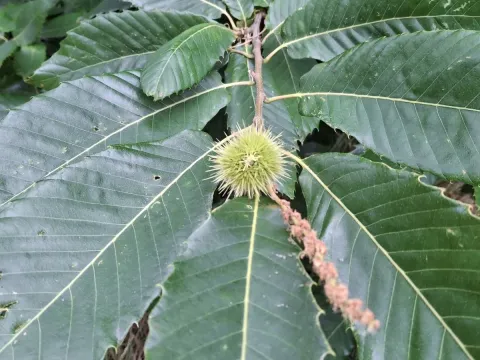
Sweet chestnut
Castanea
Planting of the sweet chestnut (Castanea sativa) is typically performed in early spring once the soil has warmed up to 10–12°C. Autumn sowing of fresh nuts directly into the field is also possible but requires strict protection against rodents.
What the section contains


Sweet chestnut
For industrial orchards, it is recommended to use two-year-old saplings with a closed root system. This method significantly improves survival rates of young trees in their permanent location.
The spacing between trees should be 8 to 12 meters, as the chestnut is a large tree with a massive canopy. High-density planting leads to reduced yields and complicates the harvesting process.
The culture belongs to the Fagaceae family. Unlike ornamental horse chestnut varieties, the sweet chestnut requires specific environmental conditions to successfully produce edible fruit.
For vegetative propagation, grafting is used to maintain superior cultivar traits and to accelerate the tree's transition into the reproductive phase.
The sweet chestnut is a heat-loving crop that thrives in regions with temperate climates. Late spring frosts are particularly critical, as they can damage young shoots and developing flower buds.
The plant requires deep, loose, and well-drained soils with a slightly acidic pH. Chestnuts strictly dislike waterlogged soils and high water tables, which lead to root rot.
Loamy or sandy loam soils rich in humus are ideal for development. On calcareous soils, trees often suffer from iron chlorosis, which negatively affects overall tree vitality and productivity.
The crop is light-demanding, so orchards should be established in open, well-lit locations that are protected from strong prevailing winds and harsh drafts.
Care involves regular irrigation during dry periods, especially during the first five years after planting, alongside a balanced fertilization program to maintain tree health.
The initial harvest for chestnut trees started from saplings usually begins 5–8 years after planting. Trees grown from seeds start producing a full crop much later, sometimes after 10–15 years.
Yield varies significantly depending on the age, cultivar, and site management. In favorable conditions, a single mature tree can produce between 30 and 100 kilograms of nuts.
Chestnut fruits are highly valued in the food industry for their high starch, sugar, and micronutrient content, making them a significant agricultural commodity in many regions.
Peak commercial productivity is reached between the ages of 20 and 50 years. Proper canopy pruning stimulates the formation of fruiting spurs and facilitates easier manual or mechanical harvesting.
Effective weed control in the tree root zone and soil mulching help retain moisture and are essential for maximizing the yield potential of the orchard.
One of the most destructive threats to Castanea sativa is the chestnut blight, caused by the fungus Cryphonectria parasitica. This disease can decimate entire plantations if not managed.
Trees are also frequently attacked by pests, including the chestnut gall wasp, which induces the formation of galls on leaves and shoots, significantly weakening the tree's physiology.
To prevent the spread of infections, it is vital to regularly conduct sanitary pruning of affected branches, ensuring they are burned outside the orchard boundaries.
The chestnut weevil is another major pest, as larvae damage the kernels inside the burrs, rendering the harvested produce unsuitable for market sale.
Disease prevention strategies include applying authorized fungicides and selecting resistant cultivars that have been bred for regional climatic conditions.
Harvesting begins in autumn when the chestnut fruits turn brown and the spiky burrs begin to open naturally on the tree branches.
In commercial orchards, harvesting is performed mechanically using specialized equipment that sweeps or gathers the fallen nuts from the soil surface.
Once harvested, nuts must be cleared of burrs and cured in a well-ventilated room to prevent mold development and maintain their shelf life and quality.
For long-term storage, nuts may undergo temperature-controlled processing or are kept under low-humidity and cool conditions to prolong freshness.
It is crucial not to delay harvesting, as nuts left on damp soil for too long lose quality rapidly due to fungal decay and moisture absorption.