
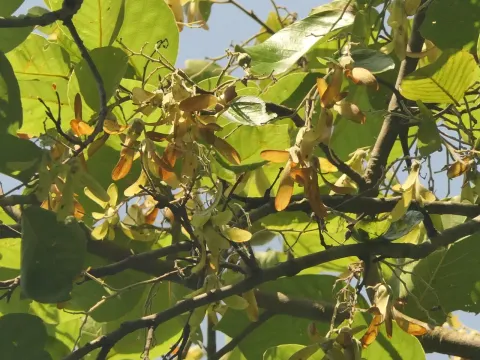
Shorea
Shorea
Shorea species are slow-growing tropical trees, so large-scale industrial planting is typically achieved through the cultivation of saplings in specialized forest nurseries.
What the section contains
 Sal tree
Shorea robusta C. F. Gaertn.
Shorea almon
Shorea almon Foxw.
Sal tree
Shorea robusta C. F. Gaertn.
Shorea almon
Shorea almon Foxw.
 Shorea contorta
 S. Vidal
Shorea contorta
Shorea contorta S. Vidal
 Shorea macrophylla
 (de Vriese) P. S. Ashton
Shorea macrophylla
Shorea macrophylla (de Vriese) P. S. Ashton
 Shorea negrosensis
 Foxw.
Shorea negrosensis
Shorea negrosensis Foxw.
 Shorea polysperma
 (Blanco) Merr.
Shorea polysperma
Shorea polysperma (Blanco) Merr.
 Shorea stenoptera
 Burck
Shorea stenoptera
Shorea stenoptera Burck
Shorea
The optimal time for establishing plantations is at the beginning of the rainy season, which provides young plants with the necessary soil moisture for establishment.
Shorea seeds lose viability very quickly after maturity, so they must be planted in a suitable substrate almost immediately after harvesting under strict temperature control.
To speed up the germination process, seeds are cleaned of their wings and sown in a light, fertile soil medium with high organic matter content.
Planting density depends on the intended end-use: for high-quality timber production, trees are spaced at least three to four meters apart to allow for proper crown development.
The genus belongs to the Dipterocarpaceae family and requires a strictly tropical climate with high ambient humidity throughout the year.
Optimal conditions for active vegetative growth include an average annual temperature range of 25–30 degrees Celsius and the absence of any seasonal cold stress.
Soil requirements necessitate deep, well-drained substrate, as moisture stagnation in the root system is detrimental to most Shorea species.
While the trees thrive in abundant sunlight, young saplings require partial shading during the initial development phases to prevent heat and radiation stress.
Protection from high winds is an important management factor, as the dense and heavy canopy can be susceptible to structural damage from severe tropical storms.
The industrial productivity of Shorea is measured not by biomass volume, but by the quality, density, and hardness of the timber harvested after a long maturation cycle.
The harvesting age for timber ranges from 40 to 80 years, depending on the specific species and the intensity of management applied to the plantation.
In addition to timber, an important secondary product is Shorea butter (sal butter), which is extracted from seeds for use in the cosmetic and food industries.
Economic yields of oil from a hectare of plantation vary significantly based on tree age and the cyclical nature of fruit production, which occurs every few years.
Seed yield for reproduction is highly variable, which makes the planning of reforestation efforts a complex challenge for tropical foresters and agronomists.
Fungal diseases are the primary threat to young plantations, particularly in areas characterized by excessive humidity and poor air circulation.
Pests such as stem borers and various leaf-eating insects can significantly reduce timber quality and interfere with the tree's annual biomass growth rates.
Improper silvicultural practices and physical bark damage create entry points for wood decay, which can destroy the structural integrity of a mature tree.
Wildfires represent a critical risk factor in natural habitats, as they can completely wipe out entire stands of young trees during the dry season.
Competition from aggressive tropical vines and fast-growing weeds necessitates regular clearing around the base of the trees during the first few years of growth.
Timber harvesting is conducted through selective logging methods, which help maintain the local ecosystem and ensure natural regeneration of the forest stand.
Seeds intended for butter production are collected manually immediately after they fall to the ground to prevent premature germination or insect damage.
Wood processing technology requires strict drying protocols, as Shorea timber is prone to warping and splitting if moisture is lost too rapidly after felling.
Logistics for transporting large logs from remote tropical areas require specialized machinery capable of operating under difficult terrain and climate conditions.
Initial processing, such as debarking and cross-cutting, is often performed directly at the logging site to optimize transport efficiency to processing facilities.