
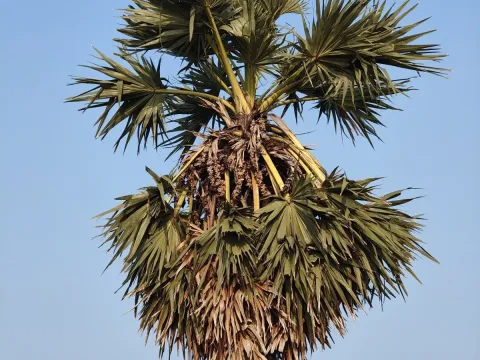
Borassus
Borassus
Propagation of Borassus is achieved solely through seeds, which require immediate planting after maturity. Seeds lose viability quickly, so they should be sown in nurseries or directly into moist soil without storage delay.
What the section contains

Borassus
Germination is a slow process that can take anywhere from several months to a year. During this initial phase, the plant focuses on developing a deep, strong taproot to ensure survival in arid environments before showing significant above-ground growth.
For commercial plantations, trees should be spaced at least 8 to 10 meters apart. This density ensures adequate light penetration for each palm, as the species is highly photophilic and does not thrive under heavy canopy shade during its juvenile stage.
Container cultivation is generally discouraged, as the taproot quickly hits the bottom of the vessel, negatively impacting the tree's development. Direct field seeding in prepared pits is the preferred method for successful establishment.
In natural settings, seed dispersal is facilitated by wildlife; however, in agricultural practice, controlled planting at a depth of 5–10 cm is utilized to protect seeds from desiccation and rodent damage.
Borassus is a member of the Arecaceae family and is a characteristic crop of tropical regions. It thrives in climates with a distinct dry season, which is advantageous for the accumulation of sugars within the plant's sap.
The crop exhibits exceptional resilience to high temperatures and prolonged drought conditions. It can grow in diverse soil types, including sandy, loamy, and saline soils, but performs best in deep, well-drained substrates.
The optimal temperature range for vegetation is between 25°C and 35°C. Borassus is strictly tropical and cannot withstand frost; consequently, its cultivation is confined to the tropical belts of Africa, Asia, and the Indian Ocean islands.
Access to groundwater or seasonal precipitation is critical for development. While adult trees are exceptionally hardy, consistent moisture availability during the establishment phase significantly enhances growth dynamics and future yield potential.
Borassus is highly tolerant of low-fertility soils, making it an essential crop for regions where marginal soil conditions preclude the cultivation of more demanding traditional agricultural crops.
The productivity of Borassus is measured by both its fruit output and its sap production. A single mature tree can yield 50 to 100 fruits annually, with the seeds containing a nutritious jelly-like endosperm.
Sap harvesting is the most valuable economic activity associated with these palms. A healthy tree can produce 5–10 liters of sap daily using traditional tapping methods, which is then processed into palm sugar, wine, or vinegar over several months of the year.
Peak productivity is attained when the tree is between 20 and 30 years old, and it maintains high yields for many decades. Borassus is long-lived, often producing for over a century, which offers long-term sustainability for plantation investments.
Quality and yield depend significantly on tree genetics and site management. Maintaining clear base areas around the trunks, free from weeds and debris, enhances nutrient and water uptake, directly influencing fruit production.
Statistical evidence confirms that structured Borassus plantation management provides a consistent food and income source in regions where other agricultural activities are frequently hampered by harsh climatic conditions.
The primary pests affecting Borassus include palm weevils and wood-boring beetles. These insects can penetrate the crown or the trunk, leading to rapid tree death if not managed through timely sanitation and preventive inspection.
Fungal diseases, such as heart rot and root rot, are often triggered by improper drainage or water stagnation around the base. These conditions weaken the palm, making it increasingly susceptible to secondary infestations.
Large wildlife, such as elephants or primates, can cause significant damage to young plantations by trampling or feeding on foliage. Protective fencing or natural deterrents are often required in areas frequented by large mammals.
Improper sap tapping techniques can serve as an entry point for pathogens. Using sterile tools and applying protective sealants to tapping cuts is essential to prevent internal tissue infection and preserve the health of the tree.
Standard preventive measures include the regular removal of dead foliage, which can harbor pests, and ensuring appropriate plant spacing to promote better airflow and reduce humidity around the palm crowns.
Harvesting Borassus fruits is a manual task requiring significant skill, as mature trees can reach heights of up to 30 meters. Skilled harvesters typically use rope-climbing techniques and specialized tools to safely reach the crown.
Sap is harvested by tapping the inflorescences of the palm. The fresh sap is collected in containers suspended at the cut point. This process requires daily maintenance at dawn and dusk throughout the peak sap-flow season.
Fruits are harvested at the stage of technical maturity when the seed endosperm is soft and jelly-like. Over-mature fruits lose their flavor and become overly fibrous, significantly decreasing their market value.
Following harvest, produce is sorted: the seeds are sold as fresh delicacies, while the hard outer shells and fibrous husks are repurposed for livestock bedding, construction material, or biofuel for farm use.
Operational efficiency in harvesting is key to plantation profitability. Rigorous safety training and the use of modern climbing gear are critical to ensuring the continuity of production and the safety of the workforce.