
Thesium zeyheri
Thesium zeyheri
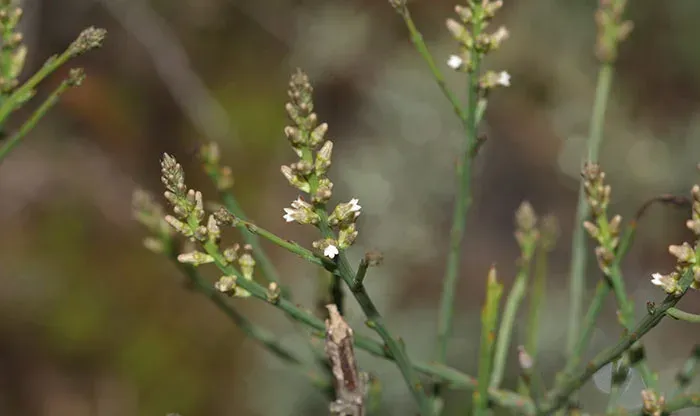
Description
Growing requirements
Thesium zeyheri is a perennial plant species belonging to the Santalaceae family. It is recognized in botany as a root hemiparasite, meaning it derives partial nourishment and water by attaching its root system to the roots of neighboring host plants.
The species is native to South Africa, where it thrives in diverse open habitats. Its distribution is closely linked to the presence of suitable host plant species, which are essential for its survival in the semi-arid and subtropical regions of its origin.
Botanically, the plant presents with delicate stems and narrow, linear leaves. The flowers are generally small and structurally simple, designed for efficient interaction with local pollinators in its native environment. It possesses specialized structures called haustoria.
Regarding growth conditions, the plant is well-adapted to environments with variable rainfall. It does not require specific intensive agricultural management, as it grows naturally in wild pastures and grasslands where it integrates into the existing plant community.
While Thesium zeyheri is not utilized as a commercial agricultural crop, understanding its life cycle is important for range management and biodiversity conservation. Its role as a hemiparasite provides unique insights into plant interactions within sensitive ecological zones.