
Thesium bergeri
Thesium bergeri
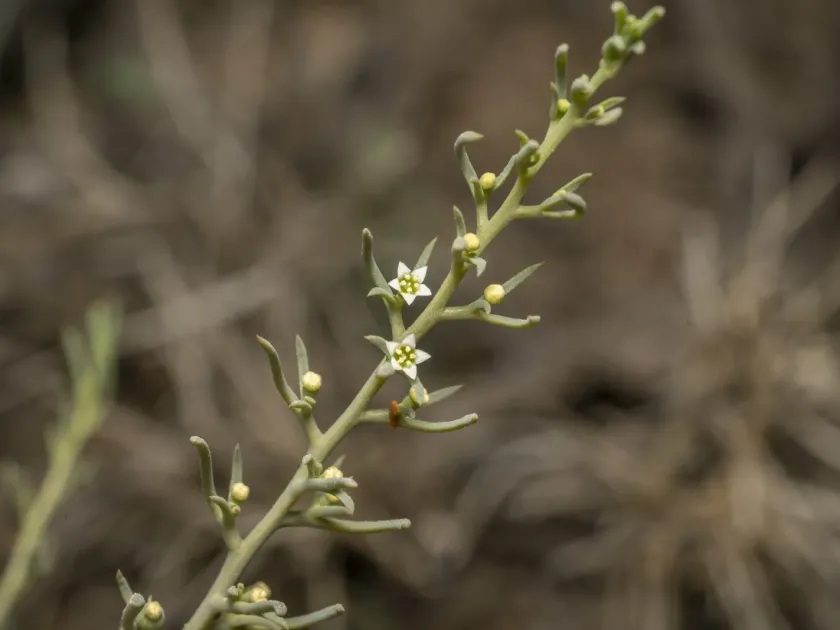
Description
Growing requirements
Thesium bergeri is a perennial herbaceous plant belonging to the Santalaceae family. It is distinct in its nature as a hemiparasite, meaning it derives some of its nutrients by attaching its roots to the root systems of nearby host plants.
This species is not classified as an agricultural crop. It does not have commercial value or cultivation practices associated with it, as it exists purely within wild ecosystems across the Mediterranean region.
The botanical structure of the plant features small leaves and a morphology adapted to arid environments. The primary adaptation for survival in nutrient-poor soils is the haustorium, a specialized root structure used to extract resources from hosts.
The plant requires well-drained, calcareous soils to thrive. It is extremely sensitive to waterlogged conditions, which inhibit the oxygen exchange in its root zone and promote the development of undesirable soil pathogens.
Environmental conditions dictate that it thrives under full sun exposure. It is highly dependent on a stable community of plant hosts, which means its presence is a reliable indicator of specific ecological stability within its habitat range.
Main diseases and pests
The primary threat to the stability of Thesium bergeri populations is the habitat destruction caused by urban expansion and land conversion, which eliminates necessary host plants required for its survival.
Soil erosion on steep hillsides poses a major risk, as it disturbs the delicate root connections between the parasite and its host, leading to dehydration and eventual death of the plant.
Fungal infections of the root system, often exacerbated by excessive humidity during mild winters, represent a biological threat that can lead to rapid localized decline of the population.
Competition from invasive plant species can crowd out the host plants that Thesium bergeri relies upon, effectively starving the population and reducing its ecological footprint.
Climate change, manifesting as prolonged droughts or unpredictable rainfall patterns, alters the phenology of the plant, potentially causing a mismatch between its growth cycles and those of its hosts.