
Southern Thesium
Thesium australe
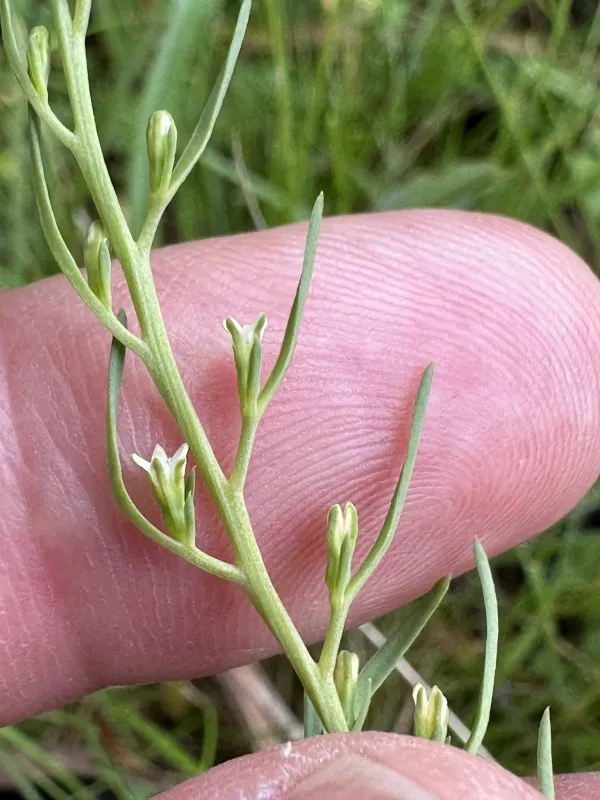
Description
Sowing dates
Southern Thesium is not a crop cultivated in agriculture, so there are no established sowing dates or agronomic practices for its propagation. In its native habitat, germination occurs naturally when seasonal conditions align with the lifecycle of its host plants.
The plant relies on hemiparasitism, meaning its seeds require contact with the root systems of specific host plants to develop. Successful establishment in the field depends entirely on the presence of these compatible neighbors.
Botanists note that seeds exhibit dormancy and often require a period of cold stratification during winter to trigger germination in the following spring. This biological mechanism ensures that the plant emerges simultaneously with its host's growth cycle.
Artificial cultivation attempts are rare and primarily focused on ecological restoration. In these cases, seeds are typically sown directly onto soil surfaces alongside native grassland species to facilitate early root attachment.
Maintaining proper moisture levels during the germination phase is critical. If the radicle does not encounter a host root quickly after emergence, the seedling lacks the stored energy to survive independently and will perish.
Growing requirements
As a member of the Santalaceae family, Thesium australe is a root hemiparasite. It derives water and mineral nutrients from host plants via specialized organs known as haustoria, which attach to the roots of neighboring vegetation.
The plant prefers open, sunlit environments such as native grasslands or grassy clearings. It does not perform well in heavily shaded areas where competition for light limits its photosynthetic potential.
It thrives in well-drained soils with a neutral pH level. While it can tolerate a variety of soil types, it is highly sensitive to excessive fertilizer applications, which can disrupt the delicate balance of the grassland ecosystem it inhabits.
Climate-wise, the species is adapted to temperate conditions with moderate rainfall. It shows resilience during periods of low moisture due to its ability to extract resources from host plants, which often possess deeper root systems.
Successful growth depends on the stability of the plant community. Any significant disruption to the local vegetation structure can jeopardize the survival of Southern Thesium by removing the necessary host species.
Main diseases and pests
The primary threat to Southern Thesium populations is habitat loss caused by land-use changes, such as the conversion of grasslands into arable farmland or urban development. This destroys both the plant and its obligate host species.
Fungal diseases, particularly those causing leaf spot or stem rot, can affect the plant during prolonged periods of high humidity. These infections weaken the plant's ability to produce seeds and expand its population.
Insect pests that target Southern Thesium are generally not a major concern; however, heavy grazing by livestock can mechanically damage the plant. This is particularly harmful during the flowering and seed-setting stages.
Herbicides pose an existential threat to this species. Because it is a dicot, broad-spectrum or selective herbicides used in agriculture to control weeds can easily eradicate it, as it lacks the physiological defenses of conventional crops.
Competition from invasive plant species is a significant concern. Invasive weeds can outcompete the native host plants or cover the ground surface, preventing the light and space required for Southern Thesium seedlings to establish.