
Branched bastard toadflax
Thesium ramosum
Description
Growing requirements
Thesium ramosum, commonly known as the branched bastard toadflax, is a perennial herbaceous plant belonging to the Santalaceae family. It is recognized as a hemiparasite, meaning it derives part of its nutritional requirements from host plants through haustoria connections in its root system.
The plant is widely distributed across the Eurasian steppes and forest-steppe regions. Its natural habitat includes dry grasslands, stony slopes, and chalk outcrops. It thrives in well-drained, alkaline, and nutrient-poor soils where it can successfully establish connections with suitable host species.
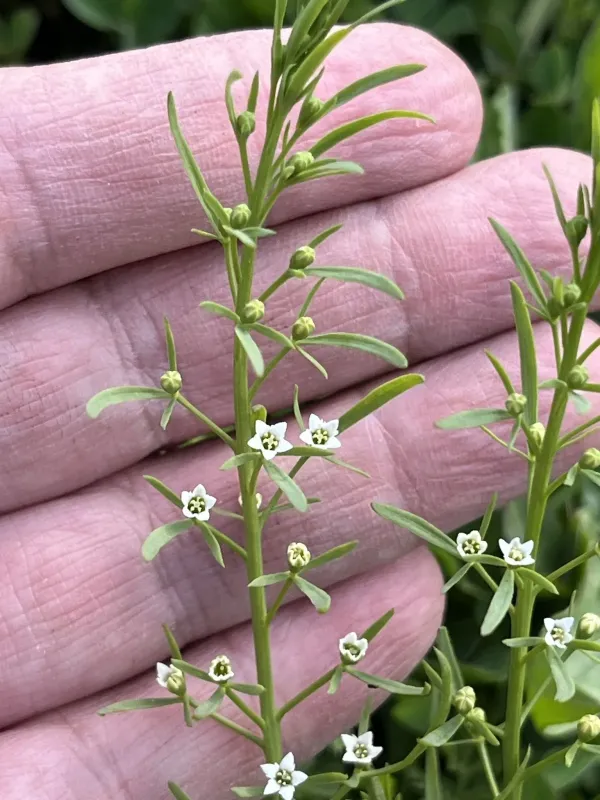
Botanically, it is characterized by its heavily branched stems reaching heights of 10 to 30 centimeters. The foliage consists of narrow, sessile, linear leaves arranged alternately along the stems. Its flowers are small, typically whitish or yellowish-green, and arranged in loose, raceme-like inflorescences.
Climatic and soil requirements for Thesium ramosum are specific to open, high-light environments. As a heliphilous plant, it cannot compete in dense, shaded vegetation. Its root system is adapted to penetrate the soil deeply to access both water and the necessary attachments to host roots for survival.
Regarding its utility in agriculture, Thesium ramosum is not considered a crop plant. It lacks industrial, food, or fodder value, and it is rarely subject to cultivation. In the context of pasture management, it is often viewed as a spontaneous component of the local flora that provides no economic benefit to agricultural production systems.