
Low bastard toadflax
Thesium humile
Description
Growing requirements
Low bastard toadflax (Thesium humile) is a small hemiparasitic plant belonging to the Santalaceae family. It is distinct for its biological strategy: while possessing chlorophyll and performing photosynthesis, it also develops haustoria to attach to the roots of neighboring host plants to extract water and nutrients.
The species is primarily native to the Mediterranean basin, parts of North Africa, and Southern Europe. It thrives in dry, sunny environments, including stony meadows and abandoned agricultural lands where it can find a stable community of compatible host species to sustain its life cycle.
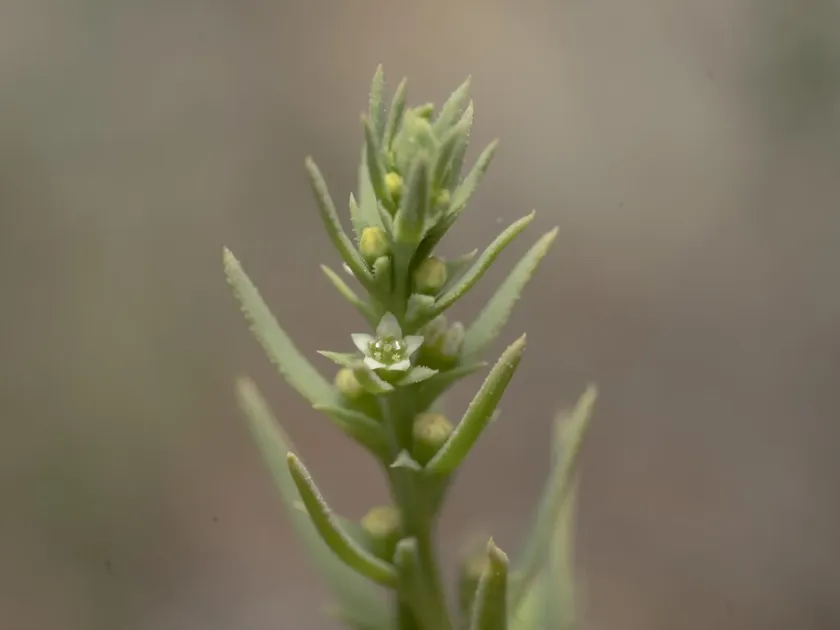
Morphologically, the plant is characterized by its slender, erect stems, linear leaves, and small, inconspicuous greenish or white flowers arranged in spikes. The fruit is typically a nutlet enclosed within persistent bracts, adapted for dispersal by wind or passing animals in open habitats.
From an agronomical perspective, this plant is not a cultivated crop but is studied for its ecological interactions in grasslands. Understanding its growth patterns helps agronomists manage grazing land, as high concentrations of hemiparasites can affect the yield and vigor of forage vegetation.
The plant demands high levels of direct solar radiation and is well-adapted to nutrient-poor soils. Its survival depends largely on the density of vegetation around it, as the presence of suitable host species is the single most critical factor for its successful establishment and growth in the wild.
Main diseases and pests
Threats to the populations of Thesium humile are closely tied to habitat loss and intensive farming practices. Overgrazing can destroy both the parasite and the essential host plants, causing a collapse of the local population dynamics in areas traditionally dominated by this species.
Fungal infections and pathogens are present in the natural environment, though they rarely act as primary population controllers. Moisture-related diseases may occur during wet springs, potentially causing wilting in sensitive specimens that rely heavily on their host's metabolic support.
The use of broad-spectrum herbicides in surrounding agricultural landscapes poses a severe threat. Because the plant relies on a host, any herbicide targeting the host's vitality will inevitably lead to the decline or death of the hemiparasite, effectively removing it from the plant community.
Competition with invasive plant species is another significant factor. If the native host flora is displaced by aggressive non-native weeds, the low bastard toadflax may lose its source of sustenance, leading to a local decline in population density and overall botanical diversity.
Climate change, manifesting as altered precipitation patterns, can disrupt the synchronized growth stages of the parasite and its host. Given its specialized lifecycle, even minor changes in the timing of the host's active season can lead to a physiological mismatch for the hemiparasitic plant.