
Townsend's cordgrass
Spartina townsendii
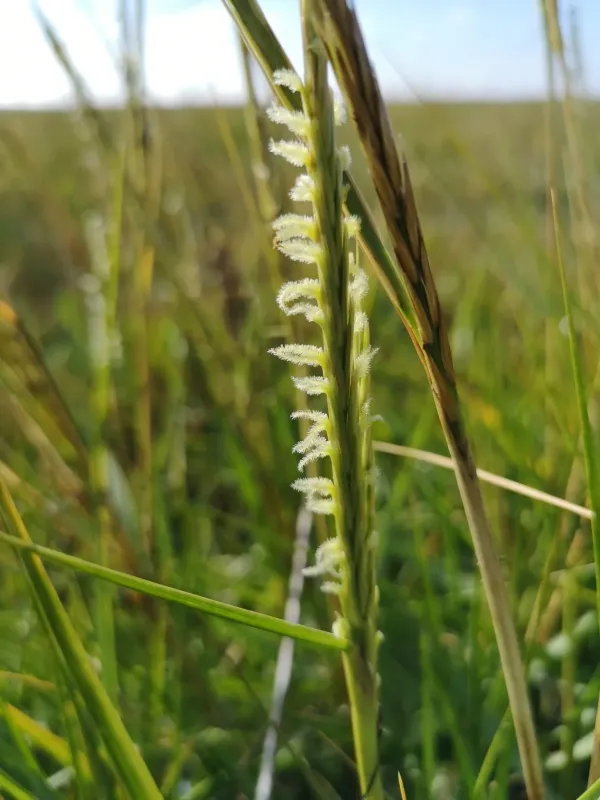
Description
Growing requirements
Townsend's cordgrass is a robust hybrid grass (Spartina alterniflora × Spartina maritima) belonging to the Poaceae family. It is a perennial species known for its remarkable ability to thrive in saline and waterlogged coastal environments.
The plant exhibits significant botanical versatility, featuring strong, creeping rhizomes that allow it to colonize mudflats and salt marshes rapidly. Its leaves are hardy and adapted to withstand high salt concentrations and periodic inundation by seawater.
Climate requirements focus on mild, maritime environments. It prefers regions without extreme frost, as the rhizomes need a stable thermal environment to support constant growth throughout the vegetative period.
Soil requirements involve wet, saline, and nutrient-rich muds. Townsend's cordgrass is highly efficient at extracting minerals from the substrate, which allows it to stabilize soft, unstable soils that are otherwise unsuitable for conventional crops.
Agronomic management involves careful selection of planting sites. Because it spreads through vegetative propagation, establishing a new colony is typically done by transplanting rhizome segments into the target muddy areas during the dormant season.
Yield
The primary use of Townsend's cordgrass is in ecological engineering, specifically for coastal erosion control and land reclamation. Its root system acts as an anchor for sediment, protecting shores from wave action.
Regarding forage production, the grass can be harvested for fodder in salt-stressed regions. While it is not the first choice for livestock, it serves as a valuable resource in areas where soil salinity precludes the growth of standard pasture grasses.
Biomass yield per hectare is generally high due to the plant's aggressive growth habit. Effective management allows for repeated harvesting, provided that the soil nutrient balance is maintained by tidal cycles.
Potential industrial applications include using the fibrous biomass for cellulose extraction or as a substrate for bioenergy production, leveraging the plant's capacity to grow on marginal coastal lands.
Economic sustainability of this crop is high, as it requires almost no maintenance, fertilizers, or irrigation, effectively utilizing the natural coastal resources to produce functional biomass.
Main diseases and pests
Key threats include various fungal pathogens such as rusts and powdery mildew, which are common in dense, humid, and poorly ventilated coastal vegetation stands.
Insect pests, including specific leaf-feeding beetles and aphids, may affect the foliage health. Managing these requires monitoring, although natural coastal breezes often help in suppressing severe pest outbreaks.
Invasive behavior is a major management concern; the plant can be aggressive and may negatively impact biodiversity if it spreads beyond the intended area of cultivation into sensitive native salt marshes.
Environmental toxicity is a risk if the grass is grown in contaminated coastal sediments, as it can accumulate industrial pollutants, rendering the harvested biomass unsuitable for animal feed.
Good management practices, such as seasonal mowing or thinning of the stands, can help prevent the accumulation of dead plant matter, thereby reducing the risk of fire and disease outbreaks.