
Rocky Mountain sage
Salvia reflexa Hornem.
Description
Growing requirements
Rocky Mountain sage (Salvia reflexa Hornem.) is an annual herbaceous plant belonging to the Lamiaceae family. In agricultural contexts, it is primarily recognized as a persistent weed that invades pastures and cultivated fields across various climatic zones.
Native to North America, the species has successfully colonized diverse regions, adapting to a range of environments. It is characterized by its ability to thrive in open, disturbed areas where sunlight is abundant and competition from taller vegetation is limited.
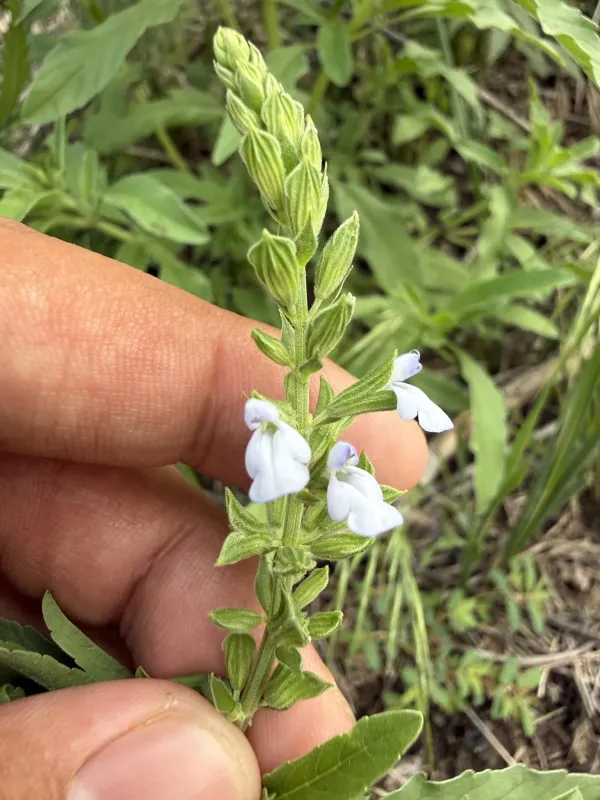
Botanically, the plant features square stems and lanceolate leaves with serrated margins. Its small, pale blue or white flowers are arranged in whorls, and the reflexed shape of the floral parts is the diagnostic feature from which the species name is derived.
Environmental requirements include well-drained soils and high levels of solar radiation. While it prefers moist conditions, the plant is remarkably drought-tolerant, allowing it to persist in semi-arid conditions where other vegetation might struggle.
The growth cycle of the plant is rapid, enabling it to produce a high volume of seeds within a single season. Its deep taproot system ensures structural stability and nutrient uptake even in compacted soils, making it a formidable competitor in agricultural land.
Main diseases and pests
The primary agricultural threat posed by this species is nutrient and water depletion in crop fields. By crowding out desirable crops, it reduces overall yield and complicates the harvesting process due to its dense, branching growth habit.
Toxicological concerns arise because the plant can accumulate high levels of nitrates, especially when growing in stressful conditions. This makes the plant potentially hazardous for livestock if consumed in large quantities, necessitating careful pasture management.
Integrated weed management strategies are essential for control. Cultivation practices, such as plowing and harrowing, are effective if performed during the early seedling stage. Preventing seed dispersal is the most critical factor in long-term field management.
Chemical control involving selective herbicides is a standard practice in commercial agriculture. Timing the application to the susceptible vegetative stage of the plant significantly improves the efficacy of control measures and prevents regrowth.
Although the plant shows resistance to many common pathogens, it can occasionally serve as a host for certain viruses and mildews. However, direct damage to the weed population from these agents is rarely sufficient to prevent its competitive impact on agricultural crops.