
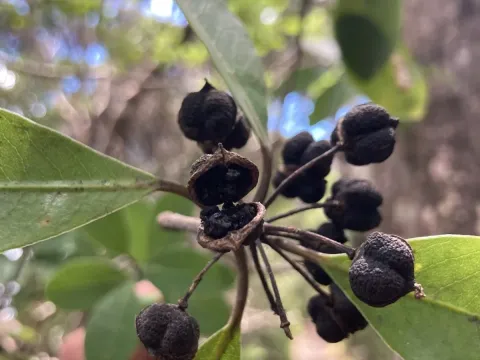
Pittosporum
Pittosporum Banks et Soland. ex Gaertn.
Pittosporum belongs to the Pittosporaceae family and comprises a diverse genus of evergreen shrubs and small trees. These plants are native to the tropical and subtropical regions of Australia, Africa, and Asia, where they thrive in warm environmental conditions.
What the section contains
 Japanese cheesewood
Pittosporum tobira (Thunb.) W. T. Aiton
Japanese cheesewood
Pittosporum tobira (Thunb.) W. T. Aiton
 Karo
Pittosporum crassifolium Banks & Sol. ex A. Cunn.
Karo
Pittosporum crassifolium Banks & Sol. ex A. Cunn.
 Kohuhu
Pittosporum tenuifolium Gaertn.
Kohuhu
Pittosporum tenuifolium Gaertn.
 Pittosporum anomalum
 Laing & Gourlay
Pittosporum anomalum
Pittosporum anomalum Laing & Gourlay
 Pittosporum bicolor
 Hook.
Pittosporum bicolor
Pittosporum bicolor Hook.
 Pittosporum colensoi
 Hook. f.
Pittosporum colensoi
Pittosporum colensoi Hook. f.
 Pittosporum eugenioides
 A. Cunn.
Pittosporum eugenioides
Pittosporum eugenioides A. Cunn.
 Pittosporum heterophyllum
 Franch.
Pittosporum tobira
Pittosporum tobira (Thunb.) W. T. Aiton x Pittosporum heterophyllum Franch.
Pittosporum heterophyllum
Pittosporum heterophyllum Franch.
Pittosporum tobira
Pittosporum tobira (Thunb.) W. T. Aiton x Pittosporum heterophyllum Franch.
 Ralph's Kohuhu
Pittosporum ralphii Kirk
Ralph's Kohuhu
Pittosporum ralphii Kirk
Pittosporum
For successful cultivation, the plant requires a frost-free climate, as it is highly sensitive to freezing temperatures. In cooler regions, it is commonly cultivated as a container plant or in professional greenhouse facilities to ensure optimal temperature control.
Soil requirements focus on well-draining, nutrient-rich substrates with a neutral to slightly acidic pH level. Proper aeration of the root system is essential, as waterlogged conditions frequently lead to root rot and other physiological disorders.
Regarding light exposure, the plant prefers bright, indirect sunlight. While it can tolerate partial shade, intense direct sunlight during the peak of summer can cause leaf scorch, necessitating the use of shading nets or strategic placement.
Agrotechnical maintenance includes consistent moisture levels and balanced fertilization during the active growing season. Regular pruning is recommended to maintain the desired shape and density, especially when the plant is used for hedge rows or interior design purposes.
The primary pests affecting Pittosporum are scale insects and spider mites, which can cause significant damage to foliage. Integrated pest management strategies, including the use of horticultural oils and systemic insecticides, are necessary for control.
Diseases such as leaf spot and root rot are prevalent when humidity levels are excessively high or air circulation is poor. Effective prevention includes maintaining adequate space between plants and ensuring that the foliage remains dry during watering processes.