
Hairy sandwort
Minuartia hirsuta
Description
Growing requirements
Hairy sandwort (Minuartia hirsuta) is a perennial herbaceous plant belonging to the Caryophyllaceae family. It is native to the mountainous regions of Europe, where it has evolved to thrive in rocky, calciferous, and nutrient-poor soils found in alpine environments.
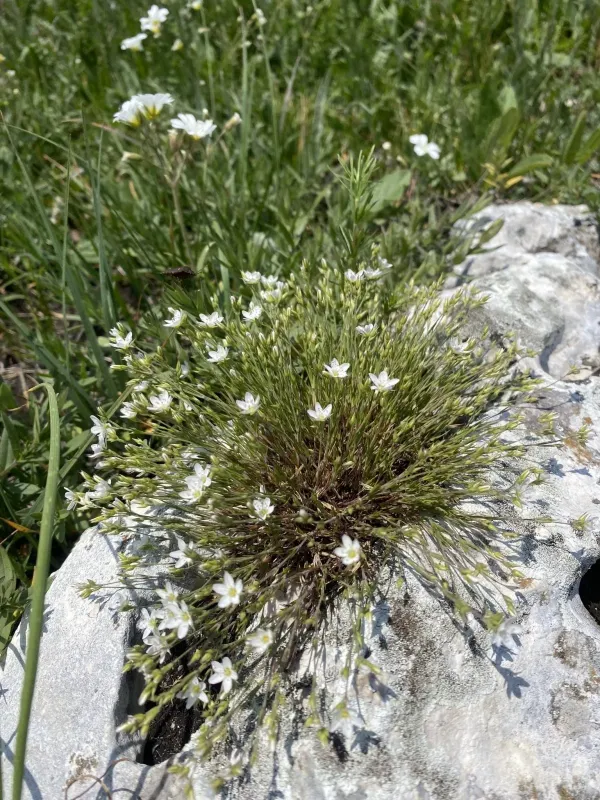
The botanical structure of the plant is characterized by dense, mat-forming, or cushion-like growth habits. Its stems are notably hirsute, or hairy, which serves as a protective mechanism against moisture loss and extreme temperatures in exposed mountain habitats.
Agricultural and gardening success with this plant depends heavily on soil texture and drainage. It requires well-draining, gritty, or sandy soils to prevent the accumulation of moisture around the root neck. Heavy clay soils are unsuitable as they often lead to root rot and failure of the specimen.
This species is highly photophilous, meaning it demands full sun for optimal health. Lack of sufficient light leads to etiolation, where the plant loses its compact cushion structure and becomes weak and sparse, significantly reducing its ornamental and biological value.
As an alpine-adapted species, Minuartia hirsuta is inherently cold-hardy. It is capable of enduring harsh winters, provided that the soil drainage prevents ice buildup around the roots. In cultivation, it performs best in exposed areas where air circulation is naturally high.
Main diseases and pests
The primary threats to Minuartia hirsuta are fungal pathogens associated with wet soil conditions. Root rot and damping-off are the most frequent causes of plant decline, especially if the cultivation site is poorly aerated or chronically damp.
Pest pressure on this species is generally low. However, in gardens or nurseries, slugs and snails can occasionally target the succulent-like foliage during damp seasons. Maintaining a clean cultivation area and managing moisture levels are the most effective preventive measures against these threats.