
Minuartia attica
Minuartia attica
Description
Growing requirements
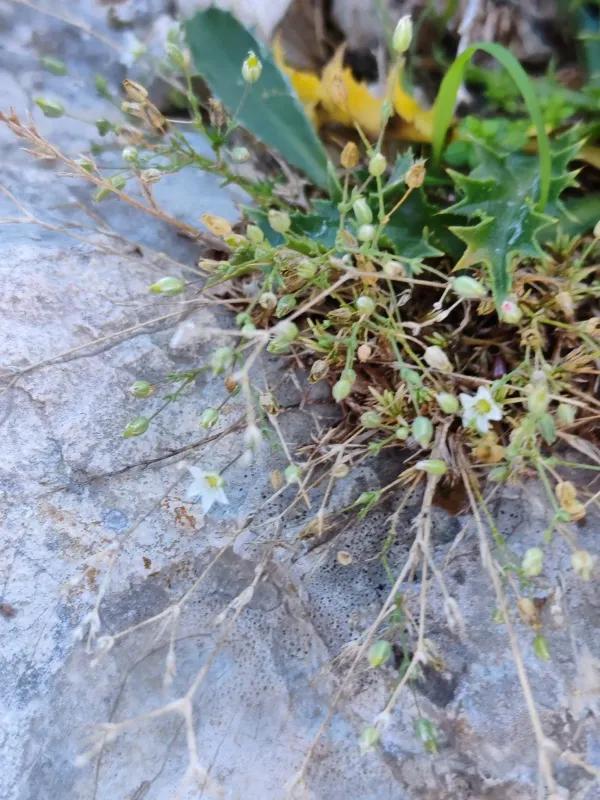
Minuartia attica belongs to the Caryophyllaceae family and is recognized for its ability to thrive in harsh, rocky environments. Its natural range spans the Mediterranean, specifically across regions in Greece, where it occupies thin soils on cliffs and slopes that are unsuitable for many other types of vegetation.
The botanical structure of the plant is highly specialized, featuring dense, cushion-forming stems covered in linear, needle-like leaves. This growth habit serves as an evolutionary strategy to reduce water loss, survive high wind exposure, and create a localized microclimate within the dense mat of foliage.
Cultivation requirements necessitate a well-draining, mineral-rich substrate. Unlike intensive agricultural crops, Minuartia attica performs best in poor, sandy, or stony soils. It requires minimal fertilization; excessive nutrient input often leads to elongated, weak stems that lose the compact aesthetic value of the plant.
Environmental management involves placing the plants in full sun exposure. It is highly heat-tolerant but susceptible to fungal pathogens if air circulation is poor or if the soil remains waterlogged. Providing a grit mulch around the base of the plant is a standard practice to keep the foliage dry and prevent decay.
Its primary agricultural and horticultural value lies in its use as a specialty ornamental plant. It is widely favored by landscape professionals for xeriscaping, alpine rock gardens, and crevices where it can develop into a durable, drought-tolerant green cover throughout the growing season.
Main diseases and pests
The most significant threats to Minuartia attica are fungal infections caused by high soil moisture, such as root rot and stem decay. Maintaining a dry neck region and ensuring porous soil conditions are the primary methods for preventing these common issues.