
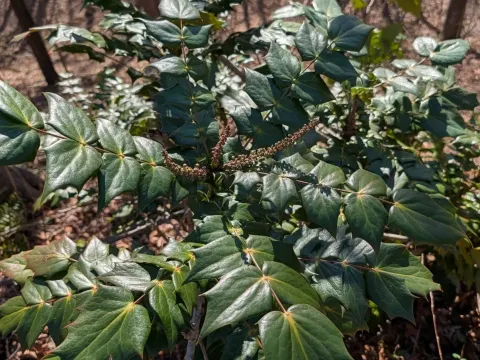
Mahonia
Mahonia Nutt.
Mahonia (Mahonia) is a genus of evergreen shrubs belonging to the Berberidaceae family. Originating from North and Central America as well as parts of Asia, these plants are highly valued for their glossy, holly-like foliage, yellow fragrant flowers, and edible blue-black berries.
What the section contains
 Creeping mahonia
Mahonia repens (Lindl.) G. Don
Creeping mahonia
Mahonia repens (Lindl.) G. Don
 Mahonia eurybracteata
 Fedde
Mahonia eurybracteata
Mahonia eurybracteata Fedde
 Mahonia japonica
 (Thunb.) DC.
Mahonia japonica
Mahonia japonica (Thunb.) DC.
 Mahonia nitens
 C. K. Schneid.
Mahonia nitens
Mahonia nitens C. K. Schneid.
 Mahonia oiwakensis
 Hayata
Mahonia oiwakensis
Mahonia oiwakensis Hayata
 Mahonia pumila
 (Greene) Fedde
Mahonia pumila
Mahonia pumila (Greene) Fedde
 Oregon grape
Mahonia aquifolium (Pursh) Nutt.
Oregon grape
Mahonia aquifolium (Pursh) Nutt.
Mahonia
For successful cultivation, Mahonia requires moist, well-draining, and nutrient-rich soil with a slightly acidic to neutral pH. While the plant can adapt to various light conditions, it prefers partial shade, as direct intense sunlight can scorch the leaves and hinder the shrub's overall health.
The plant is known for its hardiness, capable of surviving cold temperatures typical of temperate climates. However, providing a layer of mulch around the base of the shrub helps maintain soil moisture during the summer and protects the root system from fluctuating temperatures during winter.
In agriculture and landscaping, Mahonia serves both aesthetic and functional purposes. The berries are harvested for culinary uses, including making preserves, jellies, and natural food colorings, while the plant's structural beauty makes it a popular choice for evergreen hedges and borders.
Agronomic management includes annual pruning to maintain shape and promote bushiness. Regular application of balanced fertilizers during the spring encourages robust vegetative growth and improves berry production, ensuring the plant remains vigorous throughout its life cycle.
The most common disease affecting Mahonia is powdery mildew, which manifests as a white coating on the leaves. To mitigate this risk, it is essential to ensure adequate spacing between plants to allow for proper airflow and to avoid overhead irrigation whenever possible.
Pests such as aphids and scale insects may occasionally infest the plants. Integrated pest management, including the use of horticultural oils or introducing beneficial predatory insects, is recommended to manage populations without harming the ecological balance of the garden.