
Jacquinia arborea
Jacquinia arborea
Description
Growing requirements
Jacquinia arborea is a perennial woody plant belonging to the Primulaceae family. Native to the Caribbean region, this species is well-adapted to coastal environments, demonstrating remarkable resilience to harsh environmental factors such as wind and saline soils, common in its natural range.
To successfully cultivate this plant, one must provide a warm tropical climate where temperatures remain well above freezing. It thrives under full sun exposure, which is necessary to trigger its characteristic vibrant orange-red flowering cycles and maintain a compact, bushy growth habit.
Soil composition is of significant importance; the plant requires a well-draining, slightly alkaline or neutral substrate. Water management involves allowing the soil to dry out slightly between irrigation cycles, as the root system is sensitive to waterlogging, which often leads to rapid deterioration.
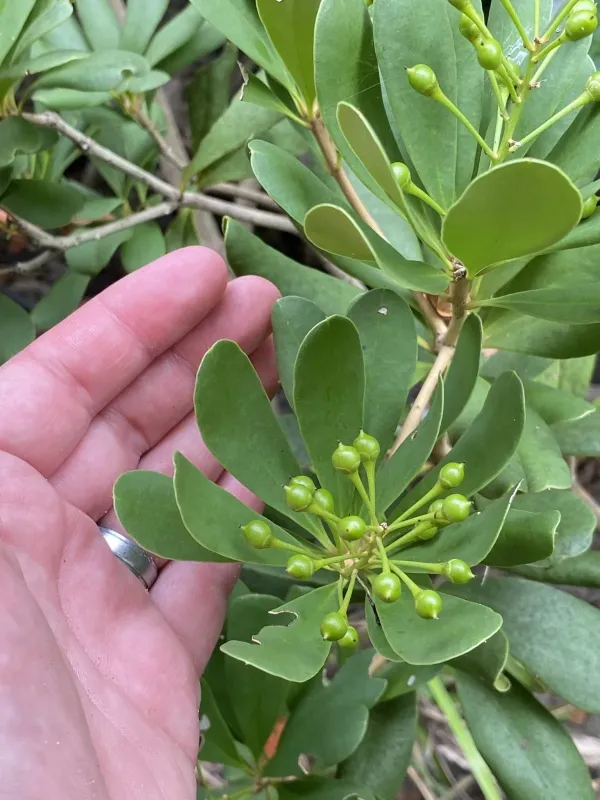
Botanically, Jacquinia arborea is known for its leathery, stiff leaves with distinct, sharp, spine-like tips. This xerophytic adaptation allows the plant to reduce water loss through transpiration, making it an excellent choice for xeriscaping or sustainable landscaping projects in hot, dry coastal areas.
In terms of agricultural and horticultural utility, the species is primarily valued as an ornamental shrub. It serves as a reliable candidate for coastal windbreaks and protective hedges, as it retains its foliage throughout the year and produces fragrant blossoms that attract pollinators.
Main diseases and pests
The primary pests affecting Jacquinia arborea include sap-sucking insects such as scale insects and mealybugs. These pests tend to congregate on the undersides of the leathery leaves or along the stems, weakening the plant if left untreated during periods of high humidity and heat.
Fungal issues, specifically those related to root rot, represent the most critical disease threat. This usually occurs when the irrigation schedule is too aggressive or the soil drainage is inadequate. Proper preventive measures include the use of fungicides specifically for soil-borne pathogens and strict irrigation control.