
Echeveria Laui-Pulidonis
hybrids between Echeveria laui Moran & J. Meyrán and Echeveria pulidonis E. Walther
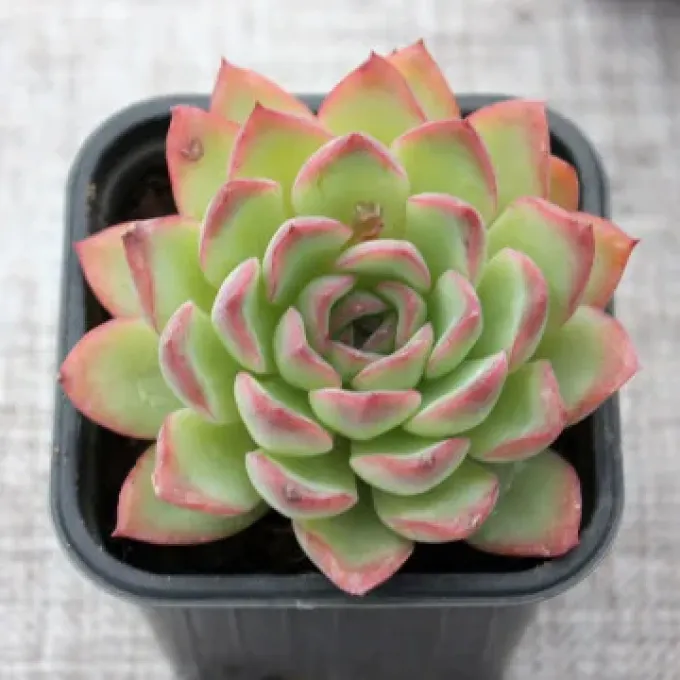
Description
Sowing dates
Propagation of this hybrid in controlled environments is typically achieved through leaf cuttings or division of offset rosettes to ensure genetic consistency.
The optimal window for vegetative propagation is spring, as the plant enters its active growth phase, facilitating faster root development and seedling establishment.
When propagating via seeds, a well-draining, sandy-peat substrate should be utilized, maintaining high humidity until germination occurs under stable temperatures.
Cuttings should be allowed to form a callus in a dry, shaded place for several days before being planted into a porous soil medium to prevent tissue rot.
Providing adequate air circulation around the young rosettes is vital to ensure robust growth and prevent premature damping-off during the first stages of development.
Growing requirements
Echeveria Laui-Pulidonis, a member of the Crassulaceae family, thrives in bright, filtered sunlight to preserve its characteristic compact rosette and waxy pruinose coating.
The substrate must be highly inorganic, consisting of pumice, grit, and sand, to provide the drainage levels required to prevent the accumulation of excess moisture.
Temperature management is critical: the plant performs best in a range of 20–26 degrees Celsius during summer and prefers cooler, dry conditions during winter dormancy.
Watering protocols must strictly follow the soak-and-dry method, ensuring the medium is completely desiccated between waterings to prevent root system hypoxia.
As an ornamental culture, it demands careful handling; the natural powdery layer on the leaves acts as a protective barrier and should never be wiped or dampened.
Main diseases and pests
The primary agronomic threat is the development of various fungal pathogens, specifically stem and root rot, caused by excessive soil moisture and poor ventilation.
Pest pressure is frequently observed from mealybugs, which tend to congregate in the delicate folds of the leaf axils, making them difficult to eradicate manually.
Spider mites can also be a significant issue in low-humidity environments, leading to distorted growth and loss of the surface bloom on the leaves.
Management involves regular inspections and the application of targeted insecticides, ensuring that oils or soaps do not compromise the plant's natural protective bloom.
- Stem rot (overwatering)
- Mealybugs
- Spider mites
- Fungal leaf spots
- Etiolation (low light deficiency)