
Echeveria hybrids
Hybrids between Echeveria affinis E. Walther, Echeveria carnicolor (Baker) É. Morren and Echeveria elegans Rose
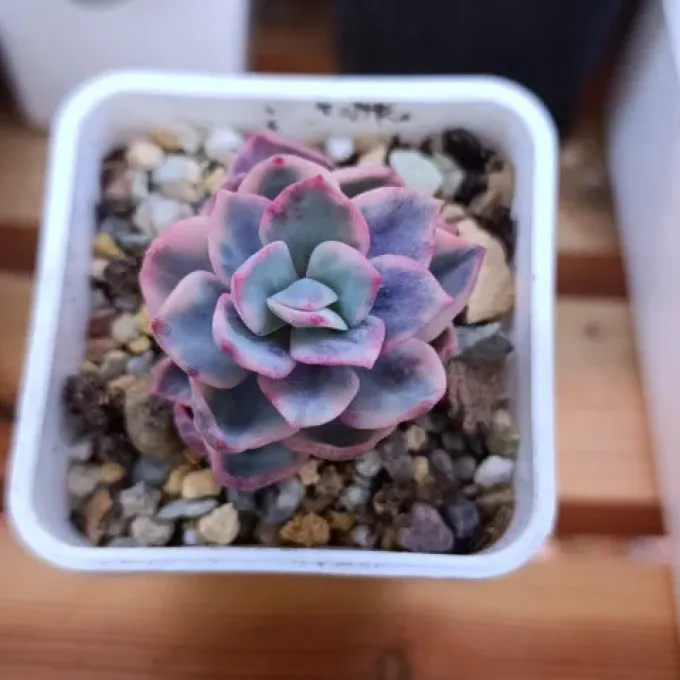
Description
Growing requirements
Hybrids derived from Echeveria affinis, Echeveria carnicolor, and Echeveria elegans belong to the Crassulaceae family. These perennials are popular succulents originating from the arid mountainous regions of Mexico, adapted to high light and low moisture.
Cultivation requires bright, indirect sunlight to maintain the compact rosette shape and vibrant foliage colors. Insufficient light leads to etiolation, where the plant stretches out and loses its characteristic aesthetic form.
The growing medium must be highly porous and well-draining. A typical succulent mix includes a balance of peat-free substrate, coarse sand, perlite, or pumice to ensure roots do not stay waterlogged for extended periods.
Temperature requirements involve warm summer days between 18°C and 25°C. A cooler dormant period during winter, ideally around 10°C to 12°C, is essential for the plant to rest and gather energy for the subsequent flowering cycle.
Watering should be deep but infrequent, allowing the soil to dry out completely between sessions. During the winter, watering is significantly reduced to mimic the natural drought cycle of their native habitats, preventing root rot.
Main diseases and pests
The primary threat to Echeveria hybrids is fungal infection, predominantly caused by overwatering or high ambient humidity. Root and stem rot can rapidly destroy the plant if the soil remains wet for too long.
Mealybugs are the most common pests, often clustering in the tight spaces between leaves. Manual removal combined with systemic insecticidal treatments is often necessary to eradicate these persistent pests from the rosette.
Spider mites can also be problematic, especially in dry environments. They cause stippling on the leaves and can significantly stunt growth if left untreated, necessitating careful observation of the plant's undersides.
Preventative measures include maintaining good airflow around the plants and avoiding overhead watering, which can trap moisture in the leaf axils and encourage fungal outbreaks or bacterial spotting.
In cases of severe infestation or decay, it is advisable to isolate the affected plant immediately. Propagating healthy leaves can often be a successful way to save the genetic line of a decaying parent plant.