
Milford's Everlasting
Helichrysum milfordiae
Description
Growing requirements
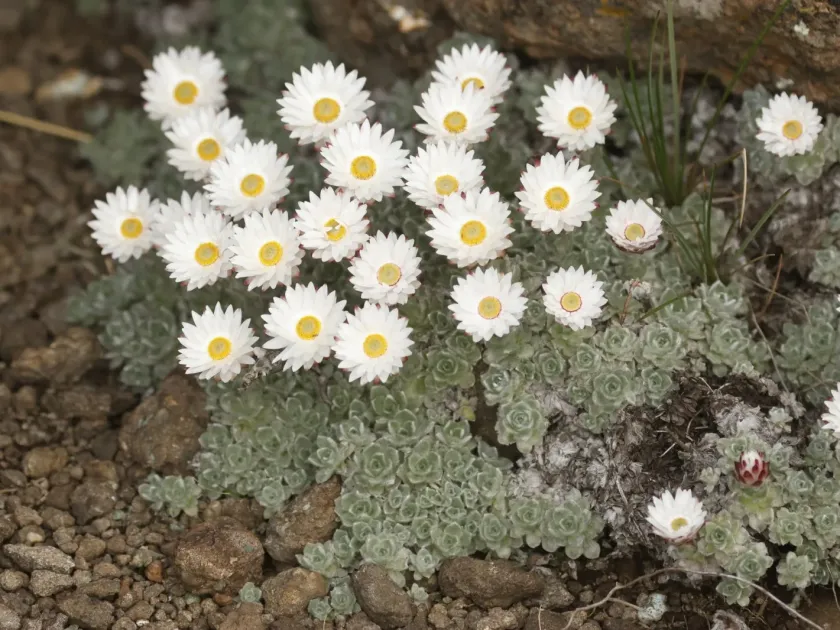
Helichrysum milfordiae, commonly known as Milford's Everlasting, is a miniature perennial subshrub belonging to the Asteraceae family. This species originates from the high-altitude rocky slopes of the Drakensberg mountains in Lesotho.
The plant is prized in horticulture for its dense, silvery, cushion-forming habit. Its small, tightly packed leaves are covered with fine hairs, allowing it to withstand the harsh environmental conditions of its native habitat, including intense sunlight and temperature fluctuations.
For successful cultivation, the plant requires a highly porous, gritty, and nutrient-poor substrate. Drainage is the single most critical factor; any stagnation of water around the roots will inevitably lead to the death of the specimen.
Milford's Everlasting demands a position in full sun to maintain its compact growth form. In a garden setting, it thrives best in troughs, rock gardens, or scree beds where the microclimate can be easily controlled to prevent excess moisture.
The plant is adapted to cold climates but suffers significantly when high humidity levels are combined with low temperatures. Providing excellent airflow is essential to mimic the windy conditions of its natural mountain environment.
Main diseases and pests
Fungal diseases are the primary threat to the health of Helichrysum milfordiae. Root rot and collar rot often develop due to poor soil aeration or excess rainfall, particularly during the dormant winter months.
Stagnant air and moisture on the foliage can encourage the growth of molds and mildews. To prevent these issues, it is recommended to keep the base of the plant free from organic debris and ensure a layer of mineral grit is present around the stems.
Insect pests, such as spider mites, may infest the plants if they are grown in enclosed areas with insufficient ventilation. Early detection is key; checking the underside of the silver foliage is a recommended periodic practice.
Over-fertilization represents a major cultural mistake that weakens the plant. High nitrogen levels lead to rapid, succulent growth that is far more susceptible to pest attacks and tissue decay compared to the natural, slow growth of the plant.
Effective management includes regular inspection of the drainage layer and careful site selection. If the plant shows signs of browning or dieback, the substrate moisture must be assessed immediately and remedial measures taken to dry out the root zone.