
Euphorbia lagascae
Euphorbia lagascae Spreng.
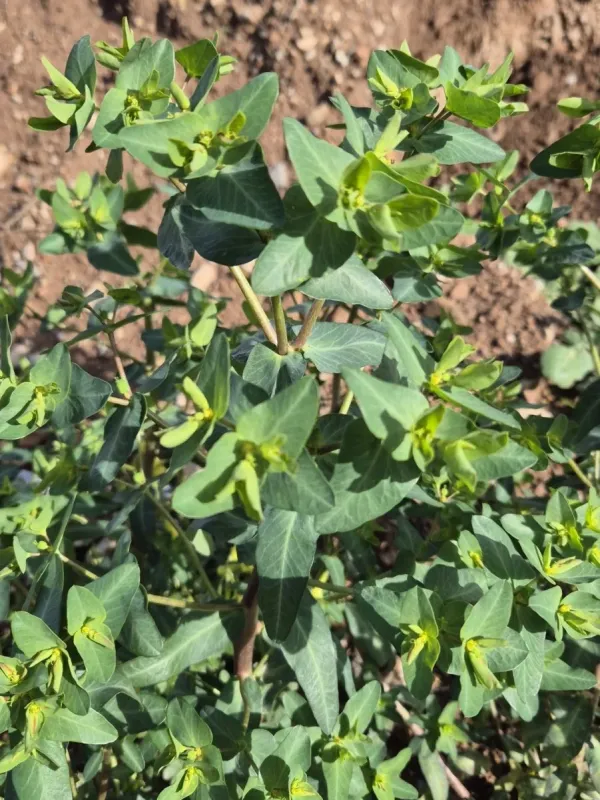
Description
Sowing dates
Euphorbia lagascae Spreng. is a promising annual oilseed crop belonging to the Euphorbiaceae family. Originating from the Mediterranean region, it has gained attention for its unique seed oil composition.
Sowing should be carried out in early spring once soil temperatures reach at least 10–12°C. Adequate warmth is essential for rapid germination and establishment of the seedlings.
The seeds should be sown at a depth of 2 to 3 cm. Proper seed-to-soil contact is critical, and rolling the soil immediately after planting helps to improve germination uniformity.
A target population density of approximately 200,000 to 300,000 plants per hectare is recommended to maximize land use efficiency and prevent overcrowding.
Early season weed management is vital. Although the crop exhibits vigorous early growth, mechanical or chemical weed control is necessary during the first few weeks to ensure a strong start.
Growing requirements
This crop thrives in sunny, warm climates and shows significant tolerance to drought conditions, making it suitable for Mediterranean-type environments.
Soil requirements are relatively specific; the crop needs well-drained, porous soil. Waterlogging is highly detrimental and often leads to root rot, which can destroy the entire stand.
The ideal soil types are light loams or sandy chernozems with a neutral to slightly alkaline pH. Soils prone to crusting should be avoided to ensure successful emergence.
Nutrient management focuses on balanced fertilization. Nitrogen promotes vegetative growth, while phosphorus and potassium are essential for flower development and oil accumulation in the seeds.
Crop rotation is mandatory to maintain soil health. It is advised to avoid planting Euphorbia lagascae in the same field for at least 3–4 years to break pest and disease cycles.
Yield
The primary economic value of Euphorbia lagascae lies in its seeds, which contain up to 50% non-drying oil rich in petroselinic acid.
Petroselinic acid constitutes about 60% of the total fatty acid content, providing a versatile raw material for the chemical industry, including detergents and lubricants.
Yield stability depends on proper agronomic practices. While it is an experimental crop, improved varieties and optimized management can lead to yields competitive with other oilseeds.
The final yield is influenced by the timing of harvest, as seed loss due to capsule dehiscence (shattering) can be significant if harvest is delayed.
Industrial processing requires specialized extraction technology to isolate the oil and remove any toxic components inherent to the Euphorbia genus.
Main diseases and pests
Root pathogens represent the most significant threat to Euphorbia lagascae. Over-irrigation or poor drainage usually exacerbates these infections.
Foliar diseases, including various leaf spots, can reduce photosynthetic surface area, leading to lower seed filling rates and reduced oil quality.
Pests such as aphids and thrips can cause damage by feeding on plant sap. Furthermore, they are potential vectors for viruses that can stunt growth.
Integrated Pest Management (IPM) is the best approach. It involves monitoring fields, maintaining high crop hygiene, and using selective insecticides only when economic thresholds are reached.
Prevention remains the most effective strategy. Using certified seeds and maintaining appropriate field sanitation significantly reduces the risk of major outbreaks.
Harvesting
Harvesting is the most challenging aspect of Euphorbia lagascae cultivation due to the tendency of the seed capsules to shatter as they mature.
Two-stage harvesting is the preferred method: the plants are swathed and left to mature in the field, followed by threshing once the capsules reach technical maturity.
Direct combining is possible only if desiccant application is used to dry the plant material uniformly and prevent premature seed release.
Post-harvest handling is critical. Seeds must be cleaned and dried to a moisture content of 8–10% to prevent spoilage and maintain oil integrity during storage.
Storage should be in cool, well-ventilated silos to prevent heat build-up and oxidation of the fatty acids within the oil-rich seeds.