
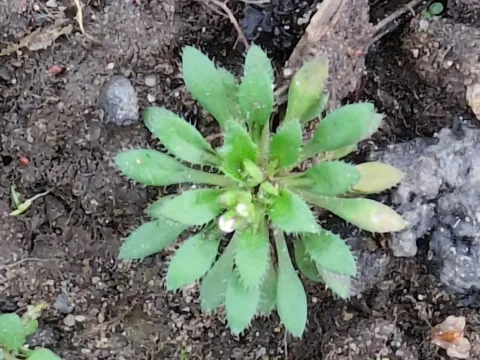
Whitlow-grass
Erophila
Whitlow-grass (Erophila) functions as a typical ephemeral, meaning its life cycle begins with seed germination under autumn or early spring soil moisture conditions.
What the section contains


Whitlow-grass
The seeds possess high germination energy at low positive temperatures, allowing the plant to develop faster than many other competing species in early spring.
In an agronomic context, the plant is classified as a weed that colonizes fields if there is no autumn tillage, spreading rapidly across fallow areas.
Natural seed dispersal occurs in early summer, after which the plants die off completely, remaining in a dormant state until the following season.
Artificial cultivation of this species is not performed, as it holds no direct agricultural value and is generally managed as a weed in crop rotations.
This plant belongs to the Brassicaceae family and exhibits high ecological plasticity, preferring open areas with direct sunlight exposure for growth.
It thrives on various soil types, including sandy, loamy, and nutrient-poor substrates, demonstrating a high tolerance for varying soil pH levels.
Sufficient winter and spring moisture is essential for its development, as the plant must complete its life cycle before the onset of summer heat and drought.
Sunlight is the primary limiting factor for its range; therefore, it is rarely found in densely shaded environments or within dense forest canopies.
In its natural habitat, the plant shows remarkable resilience to sudden temperature drops, which is an evolutionary adaptation to the unpredictable spring climate.
Due to its very short vegetative period, whitlow-grass is rarely impacted by severe diseases that usually affect other members of the Brassicaceae family.
However, under high humidity and density, it may serve as a host for powdery mildew, which could potentially spread to neighboring commercial crops.
Pests such as small insects feed on its vegetative mass, but the damage is usually insignificant to the population due to the plant's rapid growth cycle.
In agriculture, it acts as a reservoir for crucifer flea beetles, which can migrate to emerging commercial crops if the weeds are not properly managed.
Field control of this species primarily involves early mechanical soil cultivation or the application of herbicides to target emerging seedlings in spring.