
Gaussen's Storksbill
Erodium gaussenianum
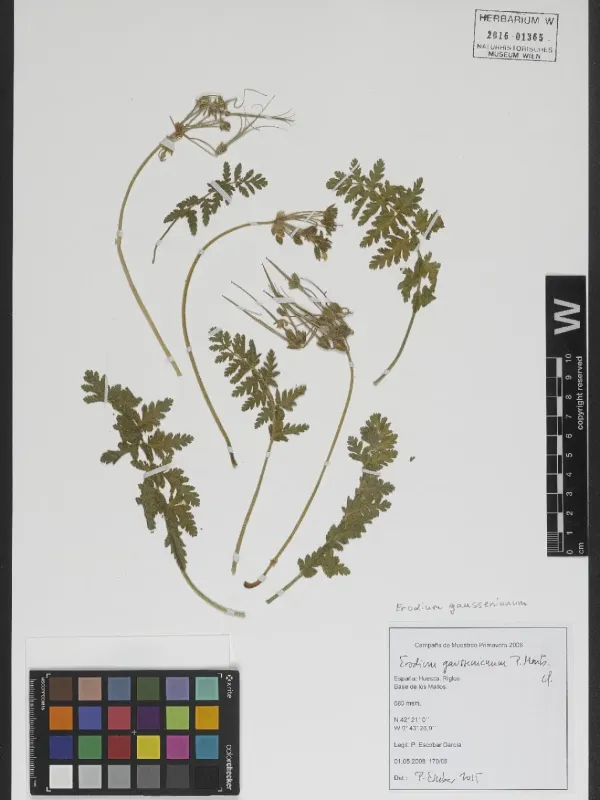
Description
Sowing dates
Gaussen's Storksbill is an endemic species found exclusively in the high-altitude regions of the Pyrenees. In its natural environment, seeds mature in late summer and fall into the soil, undergoing a period of natural cold stratification.
Cultivation of this plant on a commercial scale is not carried out due to its conservation status and specific ecological requirements. In botanical collections, seeds are sown in a soil mixture with a high drainage proportion during the autumn season.
An essential condition for seed germination is providing night and day temperature fluctuations that simulate an alpine climate. The use of growth stimulants when sowing under controlled conditions promotes more uniform germination of young specimens.
The sowing depth must be minimal, as the seeds are small and sensitive to substrate density. Using coarse-grained sand as a top layer helps prevent root neck rot during the initial stages of development.
After emergence, the plants require careful transplanting into individual containers with an inert mineral substrate, which eliminates excessive moisture accumulation and the risk of fungal infections.
Growing requirements
The plant belongs to the Geraniaceae family and is a highly specialized species adapted to the harsh conditions of high-altitude rocky screes. It prefers areas with high intensity of solar illumination.
For normal growth, Gaussen's Storksbill requires soils with low organic matter content, a high degree of aeration, and a neutral or slightly alkaline pH. Waterlogging is lethal for this species.
Climatic requirements include the necessity of a prolonged dormant period in winter at temperatures below freezing. The plant possesses high frost resistance but poorly tolerates wet and snowless winters with frequent thaws.
In its natural habitat, the species grows at altitudes characterized by strong winds and high air dryness. This makes it extremely sensitive to substrate moisture levels when grown in closed ground, requiring specialized drip irrigation.
When cultivating in rock gardens, it is necessary to mimic rocky soil structures by adding large amounts of gravel and crushed stone, which ensures ideal water drainage from the plant's root system.
Main diseases and pests
The main danger to the population is climate change, leading to a reduction in the area of their natural habitats. Global warming is pushing this high-altitude species into narrower ecological niches.
Under conditions of poor agrotechnical practices, plants are often affected by root rots caused by pathogenic fungi from the Pythium and Phytophthora genera, which thrive in excessive moisture.
Pests such as spider mites can cause damage in conditions of low air humidity when grown in greenhouses. Damage to the leaf blade leads to a sharp weakening of the plant's photosynthetic capacity.
Competition from more aggressive herbaceous plant species in the natural environment is a significant biological risk factor. Reduced grazing leads to the overgrowth of screes, depriving Gaussen's Storksbill of necessary space.
Any anthropogenic impact, including plant collection or disruption of the rocky surface integrity, has a critical effect on the survival of local populations, which are protected by nature conservation organizations.