
Stemless stork's-bill
Erodium acaule
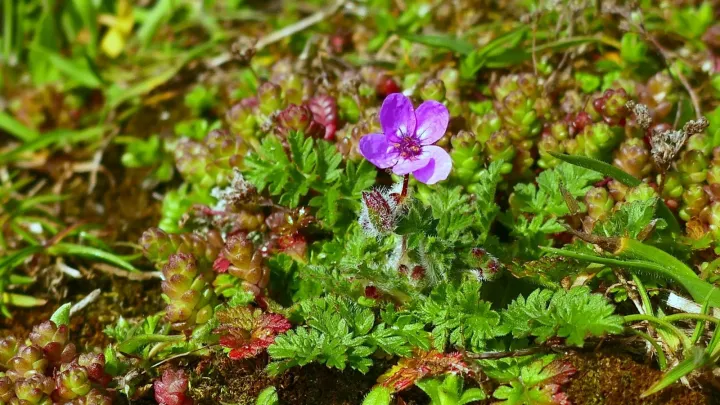
Description
Sowing dates
The stemless stork's-bill is a plant that primarily reproduces via seeds in its natural habitat. For cultivation or introduction, it is recommended to sow seeds in late autumn or early spring, as soon as the ground is workable and retains sufficient moisture.
The seeds demonstrate high germination rates, though stratification may be required for more uniform emergence. Sowing should be done in rows with a spacing of 30–45 centimeters between rows to ensure sufficient growing space for the leaf rosettes.
Seed planting depth should be limited to 1–2 centimeters, as the seeds are quite small. When sowing directly into the soil, it is crucial to ensure good contact between the seeds and the soil surface to improve capillary water uptake.
In industrial cultivation, weed control during the first weeks of development is essential. As the plant exhibits slow initial growth, competition from more aggressive weed species can be highly detrimental to establishment.
Applying mulch shortly after germination helps preserve soil moisture and suppresses weed growth, promoting better rooting of the crop under field conditions.
Growing requirements
The stemless stork's-bill is a perennial herbaceous plant belonging to the Geraniaceae family. Being adapted to Mediterranean conditions, it prefers well-lit, open areas with direct sunlight exposure.
This plant shows remarkable drought tolerance, making it a promising candidate for regions with limited irrigation. Its deep root system allows it to access moisture from lower soil profiles even during extended dry spells.
The crop does not have specific soil preferences but thrives best in light, well-drained sandy or loamy soils. Excessive moisture or water stagnation can lead to rot in the basal rosette, which can be fatal for the plant.
Optimal soil pH levels for this crop range from neutral to slightly alkaline. In heavy clay soils, plant development is significantly impaired, requiring structural improvement through the incorporation of sand or gravel.
The plant handles high summer temperatures well, but its overall productivity depends largely on the temperature regime during the active spring growth period and early summer.
Yield
Economic use of the stemless stork's-bill spans the pharmaceutical and landscape design industries. The plant's biomass is valued for its specific bioactive compounds, which serve as raw materials for phytopharmaceuticals.
Yields of green biomass are heavily dependent on soil fertility and the level of agronomic management. Under favorable conditions, a significant volume of vegetative mass can be harvested annually for processing.
An important feature is the plant's role as a ground cover, which helps in soil erosion prevention. In such cases, productivity is measured both by biomass yield and its ability to cover and protect the soil surface.
For medicinal raw material harvesting, timing is critical: peak concentrations of beneficial compounds are found at the beginning of the flowering stage. Since the plant can regenerate after cutting, multiple harvests per season are often possible.
Economic viability increases when the crop is integrated into rotations with drought-resistant cereals or used for phytoremediation on degraded land sites.
Main diseases and pests
The main threats to the stemless stork's-bill are fungal diseases, which typically arise when soil moisture regimes are not properly managed. Root rot is particularly dangerous, especially in soils with poor drainage.
Regarding insect pests, aphids pose the greatest risk by colonizing the basal rosette and sapping energy from young leaves, which slows growth and reduces the quality of the harvested material.
Seedlings may be susceptible to soil-dwelling pests like wireworms or weevil larvae, making seed treatment or proactive soil monitoring essential components of the plant protection strategy.
Powdery mildew can also affect the vegetation during periods of high humidity and moderate temperatures. Prevention focuses on maintaining optimal plant density and ensuring adequate air circulation across the field.
For large-scale pest management, the use of biological insecticides is recommended to maintain the purity and medicinal quality of the raw plant material.
Harvesting
Harvesting the stemless stork's-bill requires careful handling to preserve the integrity of the leaf rosettes. Manual or mechanical cutting should be performed during dry weather to prevent rot during the drying process.
After harvesting, the green mass must be dried immediately in a well-ventilated area or specialized dryers at temperatures not exceeding 40–45 degrees Celsius to preserve volatile oils.
If the harvest objective is seed production, it should be conducted precisely when the pods turn a characteristic brownish color. Timely collection is essential to avoid mass seed shedding, which occurs quickly in dry conditions.
Seeds are cleaned of debris, dried to an 8–10 percent moisture content, and stored in paper or cloth bags in a cool, dry place away from direct light.
When cultivating as a perennial, a light hilling-up procedure after the final autumn cutting helps the plant survive winter and protects the crown from severe temperature fluctuations.